

Keep it if it still protects and fits well, or pass it on to someone who can use it. If the case is cracked, loose, or blocks the camera or charging port, do not bin it with your kerbside recycling. Look for a manufacturer take-back or specialist recycling scheme instead, since mixed-material cases usually contaminate standard recycling streams.
TL;DR:
- Keeping, passing on, or repurposing a phone case depends on its condition and material, with intact, well-cleaned cases being suitable for reuse or donation.
- Recycling mixed-material cases is often unfeasible through standard kerbside collection, so look for manufacturer take-back schemes or postal services that handle complex materials properly.
- Signs that a case must be replaced include cracks, loose fit, obstructed ports, missing buttons, or grip loss, with a focus on accurate model compatibility before purchasing a new one.
- Repairing minor issues like grime, grip loss, or loose trims can extend a case’s usefulness, but softening corners or broken fit compromise protection regardless of appearance.
- Most old or damaged cases are better kept out of general waste, as their complex materials complicate recycling and dedicated schemes are designed for proper disposal and material recovery.
Table of Contents
- Options at a glance: how to pick a route for your old case
- Keep and repair: quick checks that extend a case’s life
- Sell, donate or swap: giving a case a second owner
- Repurpose ideas: turning an old case into something useful
- Recycle and take-back: what UK guidance actually says
- When to replace an old phone case for good
- Why reuse-first beats reaching for the recycling bin
- Finding a replacement case, including for hard-to-find phones
- Quick links: official guidance and take-back schemes
- Sources
- FAQ
Options at a glance: how to pick a route for your old case
Not every old case deserves the same fate. Some are worth keeping, some deserve a second owner, and some genuinely belong in a specialist recycling stream rather than your black bin.
The simplest way to decide is a rough hierarchy: reuse first, then pass it on, then repurpose, then recycle through a proper take-back route, and only send it to residual waste as a last resort. Where a case lands on that list depends mostly on its condition and material.
- Reuse: clean fit, no cracks, ports and camera clear. Keep using it.
- Pass on: cosmetically sound but you’ve upgraded phones. Sell, swap or donate.
- Repurpose: worn or slightly damaged but the material is still workable. Turn it into something else at home.
- Recycle/take-back: cracked, split, or made of mixed materials that kerbside collections cannot process.
- Residual waste: genuinely broken beyond any of the above and no take-back scheme covers the material.
One quick hygiene note before you pass anything along: give the case a proper wipe with antibacterial wipes or a mild soap solution, particularly the inside lip, since that’s where skin oils and dust build up over months of daily handling.
Keep and repair: quick checks that extend a case’s life
Before writing off a vintage phone case, run through a few basic checks. Press each corner to feel for cracking or softening. Check that the camera cutout still lines up cleanly with the lens, that charging ports aren’t clogged with fluff, and that button covers still respond with a proper click rather than a mushy press.
Three low-effort fixes solve most common problems:
- Clean it properly. Warm water, a little washing-up liquid, and an old toothbrush lift out grime from textured grips and camera rings.
- Restore grip. A strip of clear grip tape along the sides fixes a case that’s gone slippery with age, and it’s a quicker fix than most people expect.
- Reattach loose trims. A dab of clear silicone adhesive along a peeling edge or trim buys months of extra use.
Sometimes a case looks perfectly fine but no longer does its job. If the corners have gone soft and no longer absorb impact, or if a once-snug case now wobbles on the phone, it’s cosmetically fine and functionally useless. That’s worth knowing before you rely on it for a drop.
Pro Tip: If your case has gone yellow rather than damaged, that’s usually oxidisation in clear TPU rather than a structural fault. It’s still safe to use, but if the look bothers you, here’s what actually causes it and how to slow it down.
Sell, donate or swap: giving a case a second owner
A retro mobile case in good nick doesn’t need to end its life in a drawer. If it’s clean, undamaged, and still fits a phone people actually own, someone else will want it.
Before listing or handing one over, wipe it down thoroughly and photograph it in decent light if you’re selling online, since presentation genuinely affects whether it gets picked up.
- Charity shops often accept clean phone accessories alongside other small electricals.
- Local swap or Freecycle-style groups are usually the fastest route for older or niche models.
- Resale marketplaces work well for cases matching still-popular phone models.
One important distinction: the case itself is not electronic waste and carries no personal data. The phone paired with it is a different matter entirely. If you’re passing on the handset too, factory-reset it and remove the SIM and memory card first, since that’s standard retailer guidance before any trade-in or donation.
Repurpose ideas: turning an old case into something useful
A protective case for old phone models rarely needs to become rubbish. The material dictates what it can become: rigid polycarbonate cases hold their shape well for trays and holders, silicone cases flex nicely into soft mats or grips, and fabric or leather-look cases suit anything involving stitching or wrapping.
- Trinket tray. Line the inside of a flat, rigid case with felt for rings, earrings or coins on a bedside table.
- Soap dish. A silicone case with raised edges drains water neatly if you cut a few small slots in the base.
- Luggage tag. Slide a business card or address label into the camera cutout, then loop a strap through a drilled corner hole.
- Cable organiser. Cut a rigid case into strips and use the curved edges as cable clips stuck under a desk.
- Small photo frame. A flat-backed case with a clear front becomes an instant frame for a printed photo.
- Desk cable holder. Stand a folding-style case upright and use the hinge slot to cradle a phone charger cable.
Finishing touches matter more than people expect. A thin fabric lining hides rough cut edges, spray paint works well on matte polycarbonate but tends to peel off silicone, and a hot glue gun beats superglue for anything load-bearing since it stays flexible rather than cracking under stress.
Pro Tip: Compostable cases are becoming more common, but they only break down properly through industrial or correctly managed home composting, so check the label before assuming a “plant-based” case belongs on your compost heap.
Recycle and take-back: what UK guidance actually says
Phones fall under WEEE regulations as electrical equipment, but a standalone case usually doesn’t, since it’s a passive accessory with no electronics inside. That distinction matters because it means the phone and the case need separate disposal routes, not one combined trip to the same bin.
Kerbside recycling rarely handles mixed-material cases well. A single case might combine polycarbonate, silicone, metal trim, and adhesive, and most council sorting facilities aren’t built to separate those layers. Chucking it in with your paper and tins risks contaminating the whole batch, a habit sometimes called wish-cycling.
- Look for a manufacturer take-back scheme tied to the case brand, if available.
- Look for a dedicated postal take-back service, several of which accept old phone cases by post for free and route mixed materials properly.
- Where a case has removable parts (a metal ring, a fabric strap), separate them before recycling if your local scheme allows it.
- If no take-back route exists locally, check your council’s guidance for large or mixed plastic items before considering general waste disposal.
Most mixed-material cases simply aren’t kerbside-friendly, which is exactly why dedicated take-back schemes exist in the first place. They’re built to handle the composite materials that ordinary recycling plants reject outright.
When to replace an old phone case for good
A few clear signs mean it’s time to stop patching things up. Any crack running through a corner, a fit that no longer clicks snugly onto the phone, an obstructed camera or charging port, missing buttons or covers, or grip that’s gone permanently smooth all point the same way.
Before buying a replacement, run through a quick compatibility check:
- Confirm the exact phone model, not just the brand, since case cutouts vary between generations.
- Check camera alignment, particularly on phones with multi-lens arrays where a slightly wrong cutout causes glare in photos.
- Test button and port fit, including whether the case supports wireless charging or MagSafe-style attachments if your phone uses them.
- Look for raised lips or bumpers around the screen edge if drop protection matters to you.
Getting the compatibility checklist right the first time saves the hassle of returning an ill-fitting cover.
Why reuse-first beats reaching for the recycling bin
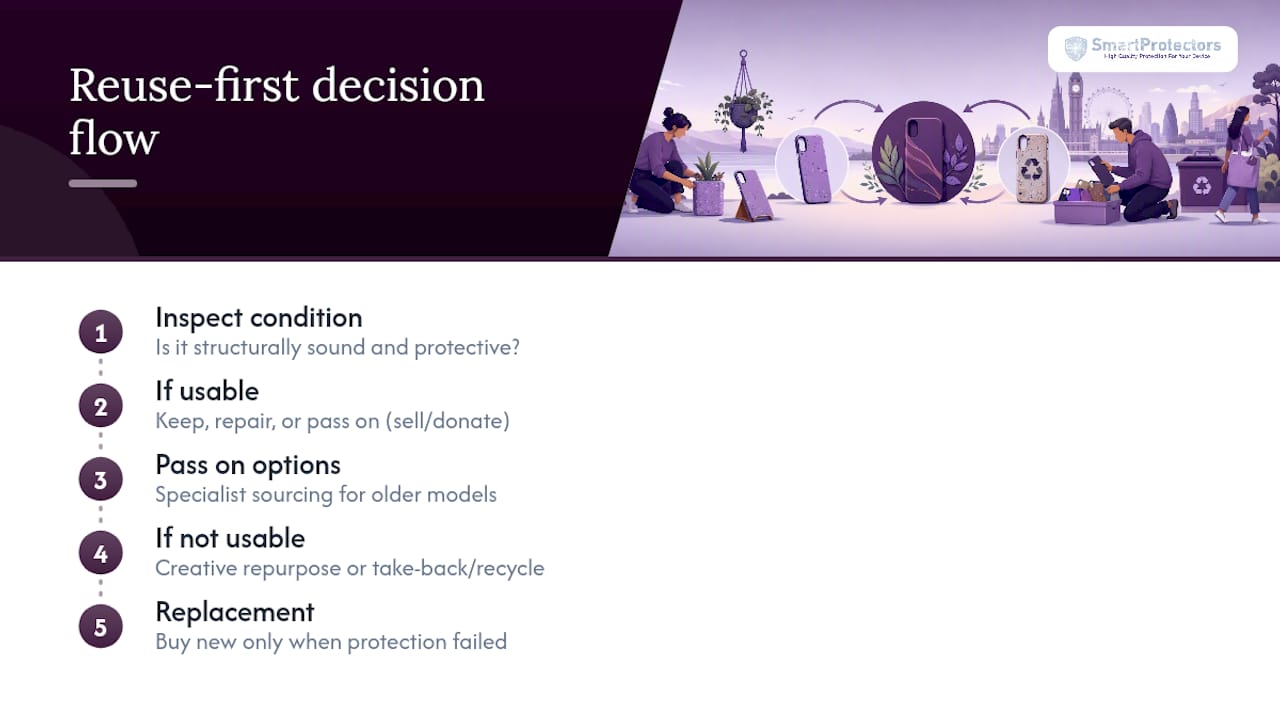
Most disposal advice jumps straight to recycling, and that’s usually the wrong instinct. Recycling a mixed-material case is genuinely difficult, and a case that still works is more valuable kept in use or handed to someone else than sent through an imperfect recycling process. The UK’s own IT Reuse for Good Charter makes exactly this case for electronics generally: reuse before recycling, wherever reuse is realistically possible.
What I think gets underestimated is how often people assume an old case has no value the moment a phone gets upgraded. It usually still does, either to you or to someone else. There are services that offer a wide product range focused on finding the right cover for awkward or older models, including request-based sourcing for handsets otherwise no longer widely available. That’s a genuinely useful safety net when “just buy a new case” turns out to be harder than it sounds.
— Dian
Finding a replacement case, including for hard-to-find phones
If your old case has finally reached the end of the road, Some companies specialize in helping customers find decent replacements without overpaying, even for phones that most shops no longer stock.
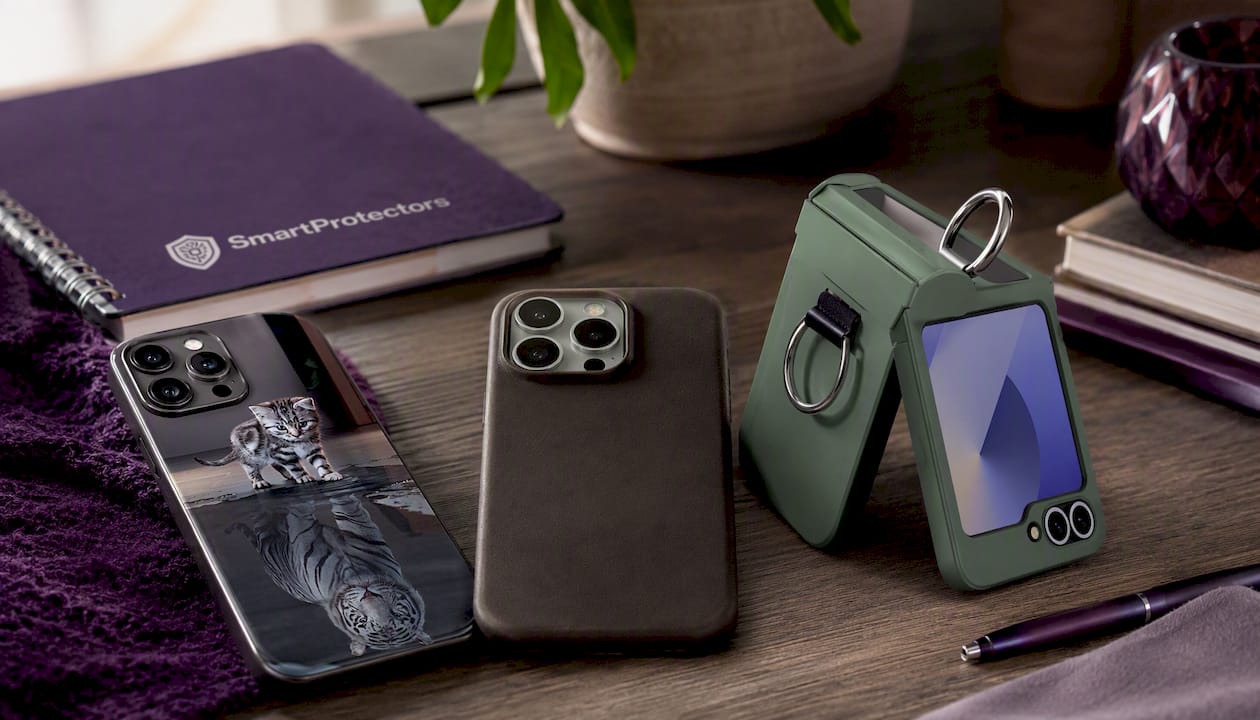
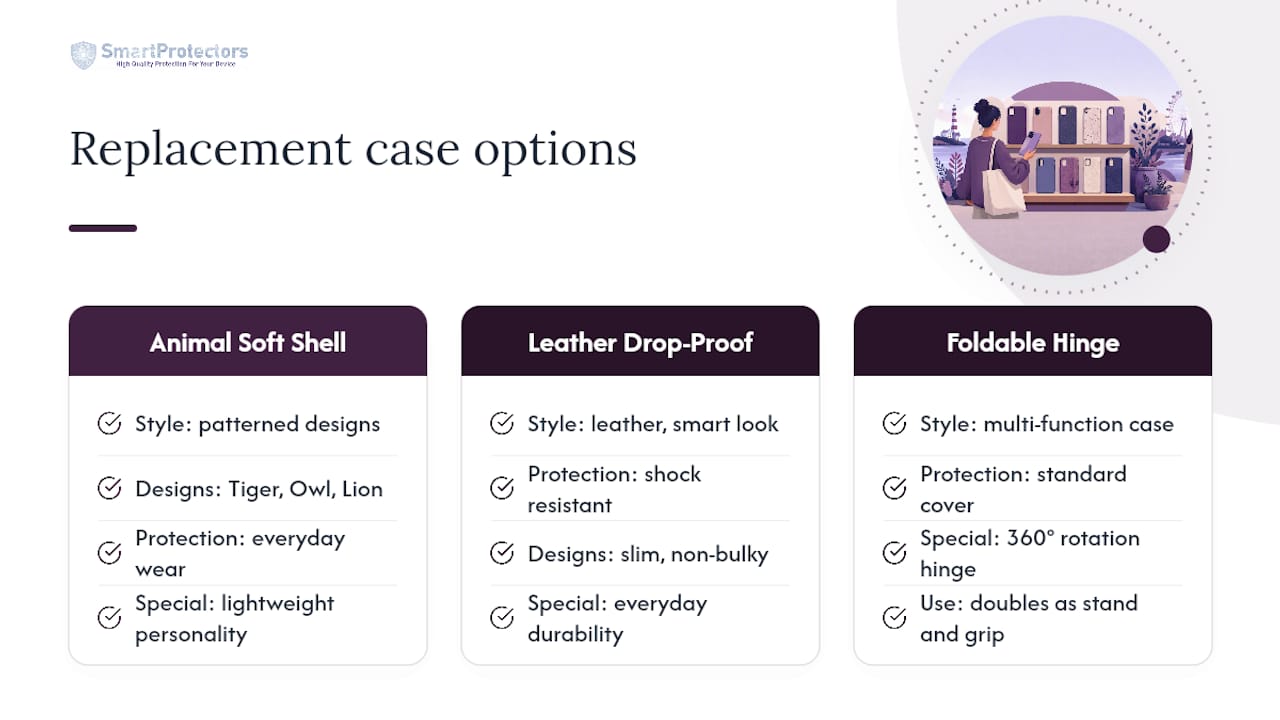
The catalogue covers a genuine spread of styles. If you want something with personality, the Animal Soft Shell Phone Case in Tiger, Owl or Lion designs suits anyone bored of plain black covers. For everyday durability with a smarter look, the Fashionable Drop-Proof Leather Phone Case offers shock resistance without the bulky sports-case look. And if you want one case that doubles as a stand and a grip, the Foldable Phone Case with Full Hinge and Ring Holder rotates a full 360 degrees, which is handy for propping a phone up while cooking or on a call.
Cannot find your exact model in the main case collection? Submit a request through a company that might source and add it to their catalogue upon request. While you’re replacing the case, it’s worth checking screen protectors and camera lens protectors too, since a new case rarely fixes a scratched screen on its own. Head to the collection page and search by your exact phone model to get started.
Quick links: official guidance and take-back schemes
For the government’s own line on electronic waste scope, see the WEEE regulations guidance. For a working postal take-back route specifically for cases, check the phone case take-back scheme. For device-specific advice before trading in a handset, Tesco Mobile’s recycling guidance covers the reset steps clearly.
Sources
- Gov
- Boringbasics
- Recycle your mobile phone - Tesco Mobile
- How to recycle your old phone case - Forge Recycling (blog)
FAQ
Where can I buy older phone cases?
SmartProtectors stocks cases for a wide range of models, including hard-to-find and older handsets, through its case collection. If a specific model isn’t listed, you can submit a request and the catalogue gets updated to include it.
Should I throw away old phone cases?
Not if you can avoid it. A usable case is worth keeping, passing on, or repurposing, and even a damaged one is often better handled through a take-back scheme than binned outright, since most cases mix materials that general waste and kerbside recycling both struggle with.
What should I do with an old phone in the UK?
Phones fall under WEEE rules and should go through reuse, trade-in, or an authorised recycler rather than general rubbish. Reset the device and remove the SIM and memory card first, following retailer guidance before any handover.
Do you really need a phone case anymore?
Yes, in almost every practical sense. Phone screens and camera modules remain expensive to repair, and even durable phones benefit from a case that absorbs everyday drops and scuffs, particularly around corners and camera housings.