

For most phones and tablets, a tempered glass protector around 0.26–0.33mm gives you the best balance of drop protection and normal touch response. Go thinner (around 0.13–0.2mm) if you want a near-invisible feel for gaming or stylus work, and go thicker (0.4mm+) only if you regularly drop your phone on concrete or work sites. Options for all three bands are available, so the right pick usually comes down to matching “used thickness” to how you actually handle your device.
TL;DR:
- For most daily use, 0.26 to 0.33mm tempered glass offers the best balance of impact protection and touch responsiveness.
- Thinner protectors around 0.13 to 0.2mm provide a near-invisible feel ideal for gaming or stylus work but offer less shock absorption.
- Thicker options over 0.4mm are suited for demanding environments like construction sites but may reduce touch precision slightly.
- Material type influences protection; tempered glass absorbs shocks differently from flexible PET or TPU films, which are less impact-resistant.
- Always compare used thickness, not just package thickness, and verify case compatibility to ensure proper fit and optimal protection.
Table of Contents
- Common screen protector thickness ranges and what they mean
- How material changes what thickness actually means
- Does a thicker screen protector really protect better?
- Why thickness affects installation and case fit
- How to choose the right thickness: a quick checklist
- Who wrote this guide and where the products come from
- Stop trusting the number on the box
- Get the right thickness without the guesswork
- Sources
- FAQ
Common screen protector thickness ranges and what they mean
Walk into any product page and you’ll see numbers like 0.15mm, 0.2mm, 0.26mm, 0.33mm, or 0.4mm listed with barely any explanation. Here’s what they translate to once the glass is actually on your screen.
Industry supplier guides consistently group tempered glass into a handful of standard bands, with 0.33mm often positioned as the retail sweet spot between protection and touch feel. Broadly, you’re choosing between three practical categories:
- Ultra-thin (≈0.13–0.2mm): Near-invisible under your finger, minimal parallax, but limited cushioning against a hard drop onto concrete or tile.
- Balanced (≈0.26–0.33mm): The default choice for daily carry. It absorbs moderate knocks and pocket scratches while barely changing how your screen feels or looks.
- Heavy-duty (0.4mm and above): Built for tradespeople, warehouse workers, or anyone whose phone lives in a bag with keys and tools. Expect a slightly more noticeable edge and a small dip in touch precision.
Scratch resistance tends to track hardness rating rather than raw thickness. A well-made 0.2mm glass with a 9H coating can resist keys and grit just as well as a thicker sheet. Drop resilience is where thickness earns its keep, since more glass means more material to absorb the shock before it reaches your screen.
Larger surfaces change the maths slightly. Tablets and laptop screens commonly ship with glass closer to 0.3–0.33mm to resist flexing across the bigger panel, since a thinner sheet stretched over a 10 or 13 inch display is more prone to stress cracks. If you’re protecting a phone and a tablet from the same household, don’t assume the same thickness suits both.
How material changes what thickness actually means
Thickness numbers only tell half the story until you know the material behind them. A 0.3mm tempered glass protector behaves nothing like a 0.3mm TPU film, even though the spec sheet lists the same figure.
Tempered glass is rigid and fails in a controlled way: it shatters into a spiderweb pattern that absorbs impact energy rather than transferring it to your actual screen. That’s why it dominates the mid-to-heavy thickness range. PET and TPU films sit at the opposite end. PET typically runs 0.1mm to 0.25mm and TPU spans roughly 0.14mm to 0.4mm, and both flex rather than crack, which is why they feel almost unnoticeable but offer far less impact cushioning than glass. Some TPU variants include a self-healing top layer that shrugs off light surface scuffs over time.
Liquid and hydrogel protectors complicate the picture further, since they add a coating rather than a distinct sheet, which is worth understanding before you assume they behave like a thin film.
- Tempered glass: rigid, thickest category, best drop absorption.
- PET film: thin, flexible, high touch sensitivity, minimal impact protection.
- TPU film: slightly thicker than PET, often self-healing, moderate protection.
- Hydrogel/liquid: extremely thin coating, flexible around curves, weakest impact resistance.
The number printed on the packaging is rarely the number that matters. Manufacturers often list total assembly thickness, which includes the adhesive layer, while the glass or film that actually sits under your finger, the “used thickness,” is the figure that determines feel and touch response. This distinction also explains why curved-edge and foldable phone owners see so much variation: curved glass needs thinner edges to bond properly, and foldable displays generally require ultra-thin film rather than rigid glass, since glass can’t flex through a hinge.
Pro Tip: If a product page lists both “assembly thickness” and “used thickness,” always shop by the second number. It’s the one your thumb will actually notice.
Does a thicker screen protector really protect better?
Yes, up to a point, but every extra fraction of a millimetre trades something back. More glass means more material standing between your screen and the ground, which genuinely improves impact absorption and scratch resistance. It also means a small but measurable shift in how the screen feels and looks.
- Touch sensitivity dips slightly as thickness increases. Fingerprint sensors under the display, in particular, can become less reliable through thicker glass, which is why many phone makers now certify specific “sensor protected” protectors for accurate unlock performance.
- Optical clarity can suffer marginally on lower-quality thick glass. Thicker material means more surface for light to pass through, which can reduce brightness or subtly shift colour rendering if the glass quality or oleophobic coating is poor.
- Edge gestures and gaming input feel the difference first. Swipe-based navigation and competitive mobile gaming both reward the thinnest reasonable protector, since any added distance between your finger and the actual panel introduces a hint of lag or reduced precision.
- Parallax becomes noticeable on thicker glass viewed at an angle. You’ll see this as a faint gap between the on-screen image and the glass surface when you tilt the phone, more pronounced above roughly 0.4mm.
The practical rule that comes out of all this: a mid-range protector around 0.26–0.33mm preserves nearly all of your native gestures and unlock speed while still giving you real protection against the drops that actually happen, fumbling it out of a pocket, or setting it down too fast on a table. You only need to go thinner or thicker once your use case pulls you towards one extreme, competitive gaming on one side, building sites on the other.
Why thickness affects installation and case fit
A protector that’s too thick for its case is one of the most common complaints in reviews, and it has nothing to do with the glass quality itself. Edge-to-edge glass designed with rounded edges can lift at the corners if a tight-fitting case presses against it, particularly once you get above 0.33mm. Cases built for a bare phone often won’t sit flush over anything thicker, leaving a visible ridge or, worse, a gap that lets dust in.
Installation difficulty varies by band too. Ultra-thin glass and film are more fragile during application, since there’s less rigidity to keep the sheet flat while you align it, so a shaky first attempt can crack it before it ever touches your screen. Mid-range glass is more forgiving and tends to self-align thanks to its own weight and stiffness.
- Look for full-glue coverage rather than edge-only adhesive, since full-glue films with a dust-free installation tray noticeably cut down on bubbles and misalignment for less experienced installers.
- Check the product page for explicit case compatibility notes before buying, especially with cases that have raised bezels.
- Favour installation kits with alignment frames if you’ve struggled with air bubbles in the past.
How to choose the right thickness: a quick checklist
Work through this in order and you’ll land on the right band without second-guessing every spec sheet.
Step 1: Rate your own drop risk. If your phone regularly ends up on pavements, in tool bags, or handed to small children, lean towards 0.33mm or above. If it mostly lives in a pocket or on a desk, the mid-range covers you comfortably.
Step 2: Pick material before thickness. Decide between rigid tempered glass for drop protection or a thinner PET/TPU film if touch precision matters more to you than shock absorption.
Step 3: Check the used thickness, not just the box. Look specifically for a spec that separates assembly thickness from the actual glass or film layer.
Step 4: Confirm case compatibility before you buy. A protector that’s a perfect thickness on paper is useless if it won’t sit flush under your existing case.
On product pages, look out for:
- A clearly stated “used thickness” figure, not just total package thickness.
- What the 9H hardness rating actually covers (surface scratch resistance, not shatter resistance).
- Whether it’s full-glue or edge-glue adhesive.
- Explicit compatibility notes for your case model.
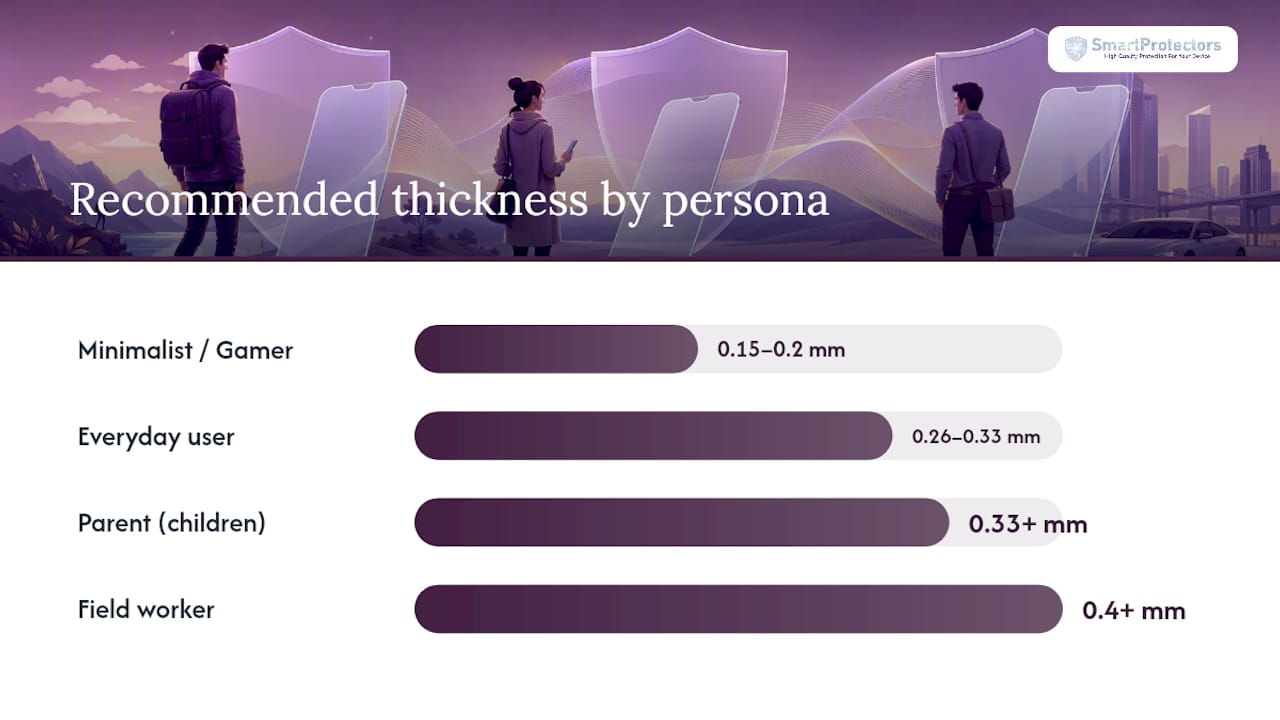
Quick persona guide: minimalists and gamers should aim for 0.15–0.2mm film or ultra-thin glass; everyday users should default to 0.26–0.33mm tempered glass; parents buying for children’s tablets should look at 0.33mm plus a protective case; and field workers should prioritise 0.4mm+ with reinforced edges.
Pro Tip: If two products list the same thickness but wildly different prices, check whether one states “used thickness” and the other only states “package thickness.” That gap in transparency often explains the price difference.
Who wrote this guide and where the products come from
This guide was written by Dian for the SmartProtectors blog, drawing on supplier technical documentation and independent buying guides on tempered glass specifications. For a deeper dive into material choice, the tempered glass buying guide covers device-specific fit considerations in more detail.
Screen protectors, camera lens protectors, cases, and back covers are sold across a wide range of phones, tablets, smartwatches, laptops, and earbuds. When a specific model isn’t already listed, customers can submit a request and products are sourced and added to the catalogue.
Stop trusting the number on the box
The conventional advice on this topic treats thickness like a single, comparable number, as if 0.3mm always means the same thing regardless of what it’s made from. That’s the part worth pushing back on. A 0.3mm PET film and a 0.3mm tempered glass sheet solve completely different problems, and packaging rarely makes that distinction obvious.
What the evidence actually supports is simpler than most buying guides admit: material decides the ceiling on protection, and used thickness decides how the protector feels day to day. Chasing a slightly higher millimetre figure within the same material barely moves the needle on drop protection, but it can noticeably dull your fingerprint sensor or swipe response.
If you take one thing from this guide, prioritise matching thickness to your actual habits rather than hunting for the “toughest” spec on the shelf. A gamer who buys 0.4mm glass because it sounds safer is trading away the exact input precision they need. A tradesperson who buys 0.15mm film because it looks premium is gambling with a screen that costs real money to replace.
— Dian
Get the right thickness without the guesswork
Reading specs is one thing. Finding a protector that actually lists used thickness, hardness rating, and case compatibility clearly is another, and that’s where SmartProtectors focuses its catalogue: straightforward listings, no inflated claims, and pricing that doesn’t punish you for wanting proper protection.
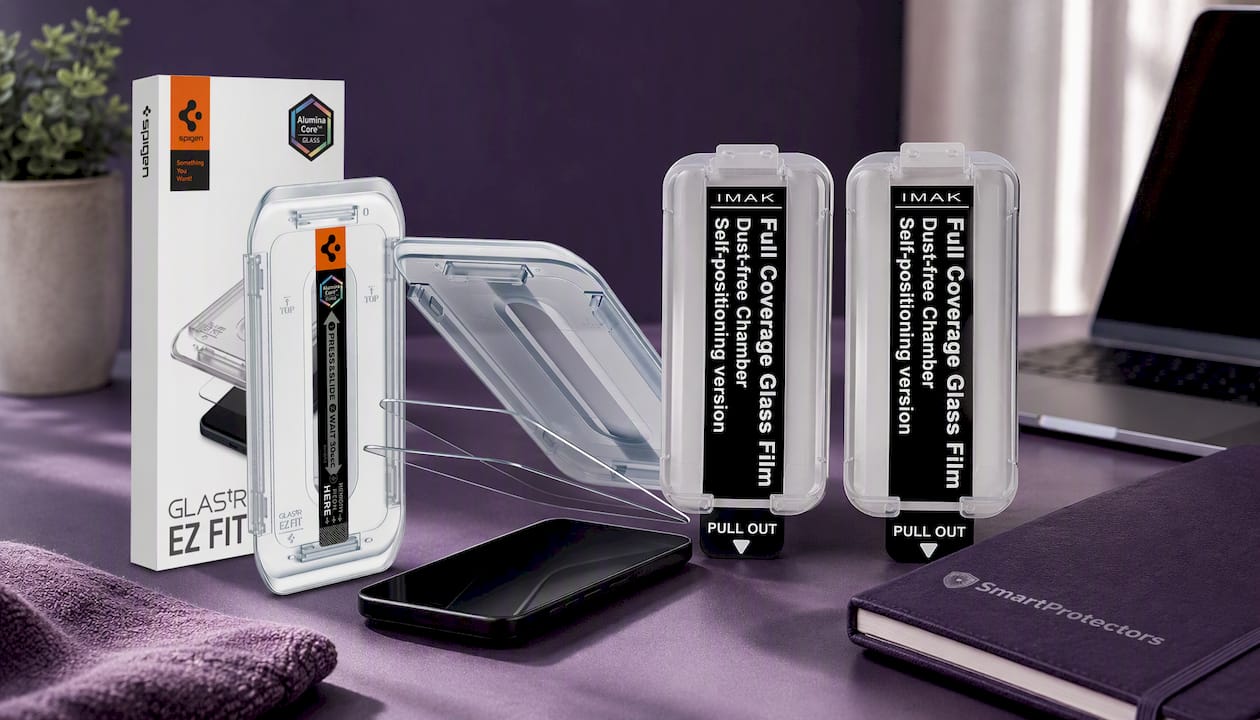
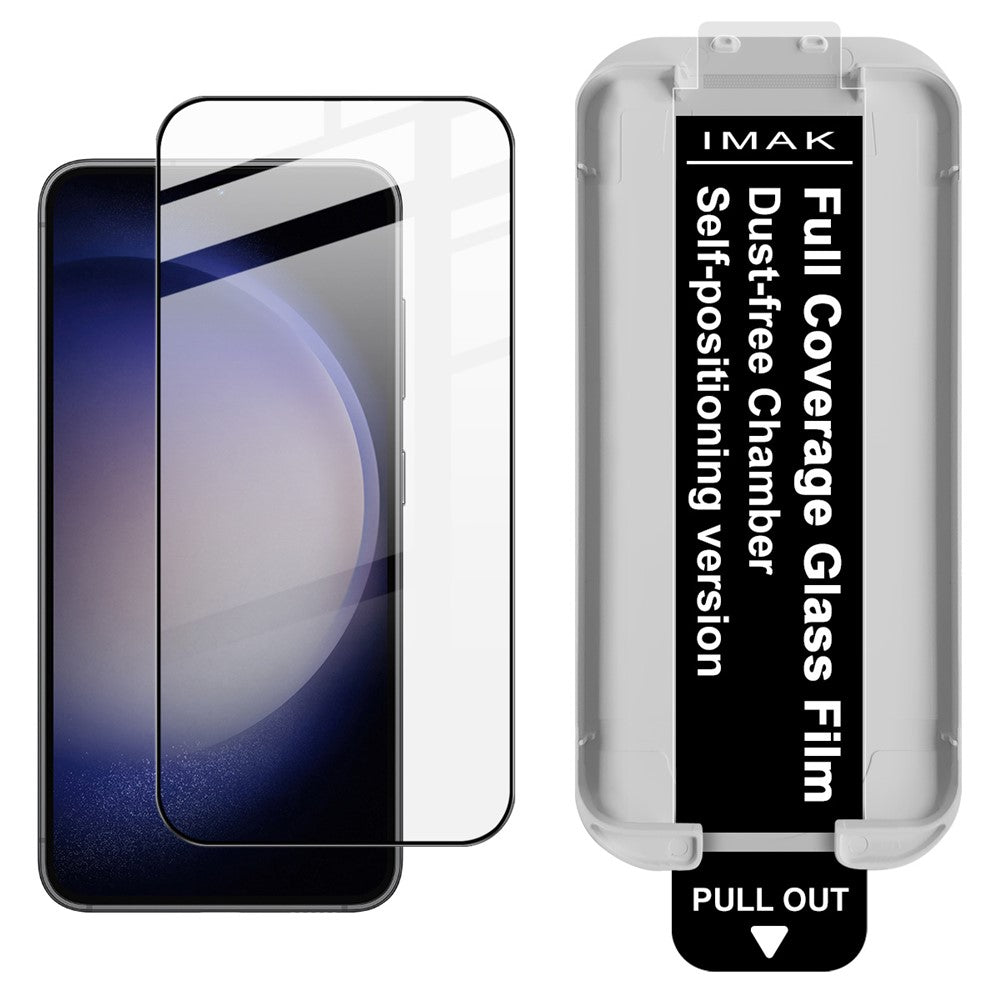
If you’re after the balanced, everyday option this guide recommends, the IMAK full-glue protector for Galaxy S25 and S24 sits right in the 0.26–0.33mm sweet spot and includes a dust-free installation tool, so bubbling isn’t a concern even for a first-time fitter. Owners of the S23 or S22 5G get the same treatment with the equivalent IMAK protector for that generation, full glue, fingerprint unlock preserved, and a guided fitting tray. iPhone 17 owners who want a precise, sensor-safe fit should look at the Spigen GLAS.tR EZ Fit protector, which comes as a two-pack and is built to keep Face ID and other sensors working properly through the glass.
Before you buy, check your exact device model and the listed used thickness on the product page. If your device isn’t there yet, browse the full screen protector range or submit a request and SmartProtectors will track it down for you.
Sources
- Tempered Glass Screen Protector Technical Guide - Alibaba.com Seller Blog
- How Thick Is Tempered Glass Screen Protector and Why It Matters – INAIRSPACE
- Screen Protector Buying Guide: Light Transmittance, Hardness, and Thickness
FAQ
What is a good thickness for a screen protector?
For most phones and tablets, 0.26–0.33mm tempered glass gives the best balance of drop protection and normal touch response. Go thinner for gaming or stylus precision, or thicker if you regularly drop your phone in rough conditions.
Is a 0.33mm screen protector good?
Yes. Independent buying guides commonly cite 0.33mm as a practical mid-range that protects against everyday knocks without meaningfully affecting touch sensitivity or fingerprint unlock.
Is a thicker screen protector always better?
Not necessarily. Thicker glass improves impact absorption but can slightly reduce touch sensitivity, brightness, and gesture precision, so the best thickness depends on your actual usage rather than chasing the highest millimetre figure.
My screen protector feels too thick. What should I do?
Check whether the listed figure was assembly thickness rather than used thickness, since packaging often includes adhesive layers in the total. If the fit or feel genuinely bothers you, switching to a mid-range or thinner tempered glass option, like those in the SmartProtectors screen protector range, usually resolves it.