

UV-cured tempered glass is the right choice if your phone has a curved display. For flat screens, a standard tempered glass protector does the job at lower cost and with a simpler installation. A UV-cured tempered glass screen protector bonds to your display using a liquid UV adhesive that is spread across the glass and then cured with ultraviolet light, creating a full edge-to-edge seal that ordinary silicone-backed protectors cannot match on curved edges.
- What it is: a tempered glass protector bonded with liquid UV adhesive, cured under UV light for complete surface contact
- Best for: curved flagship displays (Samsung Galaxy S series, Huawei P series, OnePlus curved models)
- Key specs to check: 9H hardness rating, oleophobic coating, high optical transparency
- UK option: SmartProtectors carries UV-compatible tempered glass protectors with 9H hardness and oleophobic coating, available for a wide range of models
Key takeaways
UV-cured tempered glass is the most effective screen protector for curved displays, bonding edge-to-edge with liquid UV adhesive where silicone-backed protectors consistently lift and peel.
| Point | Details |
|---|---|
| Best use case | UV-cured protectors are designed for curved displays; flat screens do not need the extra complexity. |
| Installation caveat | Cure quality depends on lamp intensity; a professional chamber gives more even results than a small hand-held LED. |
| Adhesive safety | Apply adhesive sparingly to avoid seepage into ports; excess adhesive and close lamp proximity can damage coatings. |
| Lifespan factor | Adhesive quality influences longevity; high-quality adhesives resist yellowing and delamination, whereas lower quality adhesives may degrade faster. |
| UK purchase option | SmartProtectors supplies model-specific UV-compatible tempered glass with 9H hardness and a special-order service for unlisted devices, at typical consumer prices. |
Table of Contents
- What is UV tempered glass and how does the adhesive cure?
- How does UV tempered glass differ from standard protectors?
- How to install a UV tempered glass screen protector
- Pros and cons of UV-cured tempered glass
- How long does UV tempered glass last, and how do you care for it?
- Does your case work with a UV tempered glass protector?
- What should UK shoppers look for when buying?
- Why SmartProtectors is a reliable UK source for UV tempered glass
- When would I actually choose UV-cured glass?
- SmartProtectors has the UV tempered glass protectors you need
- Sources
What is UV tempered glass and how does the adhesive cure?
The term “UV tempered glass” is shorthand for a UV-cured tempered glass screen protector. The glass itself is standard chemically strengthened tempered glass; what makes it different is the adhesive layer and how it bonds to your screen.
A conventional protector uses a pre-applied silicone adhesive on its underside. A UV-cured protector arrives with a separate bottle of liquid UV adhesive. You spread that adhesive across your phone’s display, lay the glass on top, then expose the assembly to ultraviolet light. The UV light triggers a photochemical reaction that polymerises the adhesive in seconds, creating a rigid optical bond across the entire surface, including the curved edges where silicone adhesives simply lift away.
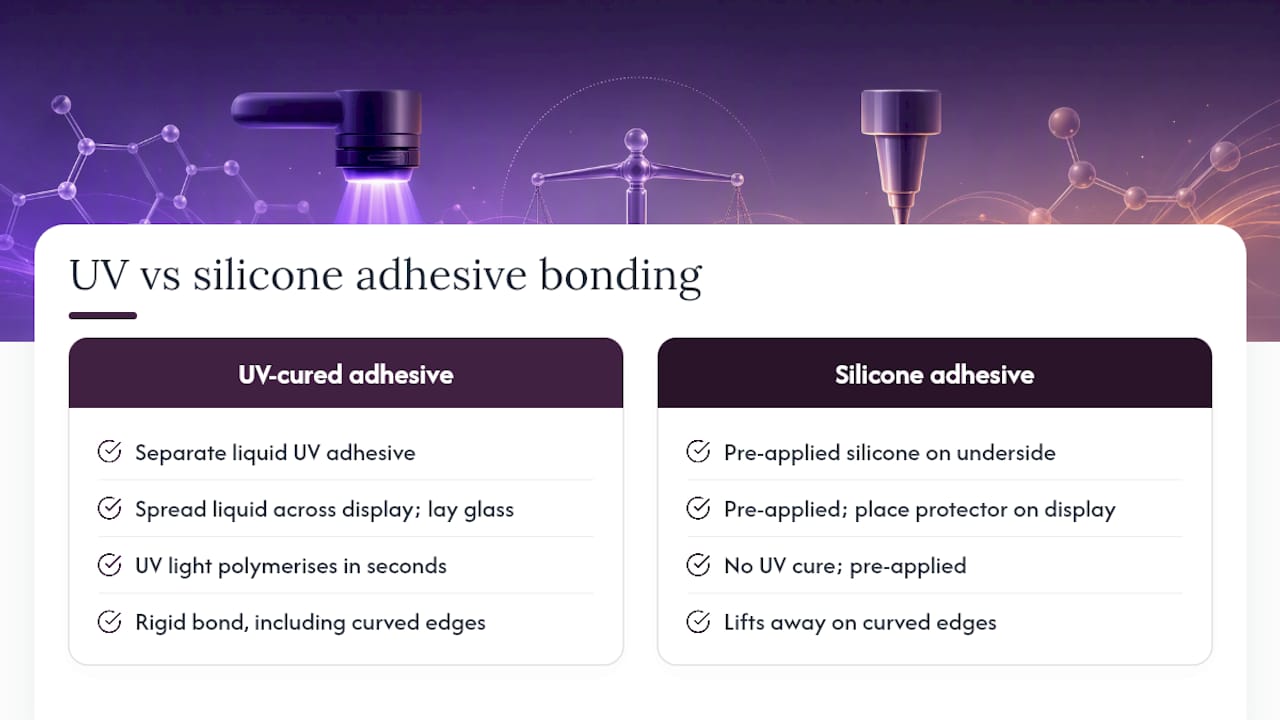
Why that matters for OLED and AMOLED panels: UV-curable adhesives are engineered for high optical transparency and fast on-demand curing, with formulations specifically compatible with AMOLED and OLED panels. Low shrinkage during curing means the adhesive does not distort the display or introduce rainbow interference patterns. The result, when done correctly, is a bond that is optically indistinguishable from the bare screen.
How the layers stack up
- Tempered glass layer: chemically strengthened to 9H hardness, resists scratches from keys and coins
- UV adhesive layer: liquid, spread manually before installation; cures to a clear, rigid film
- Oleophobic coating: applied to the outer surface to repel fingerprints and skin oils
- UV curing: 60–120 seconds under a UV lamp or chamber, depending on the lamp’s intensity
Retail guidance confirms that UV-applied protectors are the realistic option for curved displays where standard silicone-backed protectors lift and peel at the edges. For flat screens, the adhesive advantage largely disappears.
How does UV tempered glass differ from standard protectors?
The practical differences come down to four things: how the adhesive works, where it makes contact, which screens it suits, and how long it stays put.
- Adhesion method: standard protectors use a dry silicone layer; UV protectors use a liquid adhesive cured in place, filling every contour of a curved screen
- Edge contact: silicone adhesives lose contact at the curve, leaving a visible lifted edge; UV adhesive bonds flush to the glass all the way to the rim
- Screen compatibility: UV-cured protectors are designed for curved displays; on a flat screen the extra complexity brings no meaningful benefit
- Touch sensitivity: a correctly cured UV bond is thinner and more uniform than a silicone layer, so touch response is typically preserved or improved
- Long-term adhesion: UV adhesives engineered for display lamination resist yellowing and delamination when correctly formulated, keeping light transmission high over time
Pro Tip: If your phone has a flat screen and you are not chasing edge-to-edge aesthetics, a standard tempered glass protector is faster to install, easier to replace, and costs less. Save UV-cured glass for the phones that genuinely need it.
How to install a UV tempered glass screen protector
Done carefully, this is a 10–15 minute job. Rushing the adhesive or the cure is where most problems start.
What you need
- Screen cleaning kit (microfibre cloth, alcohol wipe, dust removal sticker)
- Bottle of UV liquid adhesive (usually included in the kit)
- UV curing lamp or chamber (included in some kits; a professional chamber gives a more even cure)
- Alignment frame if supplied
- A clean, dust-free environment
Step-by-step installation
- Clean the screen thoroughly. Use the alcohol wipe, then the microfibre cloth, then the dust sticker. Any particle trapped under the glass will be permanent once cured.
- Apply the UV adhesive. Dispense a thin, even line of adhesive across the centre of the display. Less is more: excess adhesive seeps into speaker grilles and button gaps.
- Place the protector. Lower the glass onto the screen, starting from one edge. Use the alignment frame if one is supplied. Press gently from the centre outward to spread the adhesive evenly.
- Check for bubbles. Small bubbles usually self-resolve as the adhesive spreads. Larger ones need a gentle press with a card wrapped in cloth.
- Cure under UV light. Hold the UV lamp 2–3 cm above the glass for 60–120 seconds, moving it slowly across the surface. Professional UV chambers deliver a more even cure than small hand-held LEDs, which can leave wet spots on curved edges.
- Wipe away excess adhesive. Any adhesive that has squeezed out around the edges should be removed immediately with a dry cloth before it cures.
- Final check. Power the screen on and check for uneven patches, which appear as slightly hazy areas. If found, re-expose that area to UV light for a further 30 seconds.
Safety note: do not look directly at the UV lamp during curing and keep it away from skin. The curing process generates mild heat; improper application or excess adhesive can damage internal components or oleophobic coatings, so follow the adhesive quantity guidance precisely.
Pro Tip: Do this in a bathroom immediately after running a hot shower. The steam settles airborne dust, giving you a cleaner working surface without a clean room.
Troubleshooting
- Persistent bubbles: usually caused by dust or insufficient adhesive spread; lift the glass carefully before the adhesive cures, clean again, and reapply
- Misalignment: if the adhesive has not yet cured, lift and reposition; once cured, removal requires isopropyl alcohol and patience
- Glue overflow into ports: stop immediately; use a dry cocktail stick to remove uncured adhesive from gaps before curing
- Partial cure (hazy patches): extend UV exposure in 30-second increments over the affected area
Pros and cons of UV-cured tempered glass
Advantages
- Full edge-to-edge adhesion on curved displays, no lifted corners
- Optical clarity comparable to bare glass when correctly cured
- 9H hardness protects against everyday scratches
- Thinner bond line than silicone adhesives, preserving touch sensitivity
- High-quality adhesives resist yellowing over time
Disadvantages
- More complex installation than peel-and-stick protectors
- Risk of adhesive seepage into speaker grilles or charging ports if over-applied
- Heat generated during curing can stress components if the lamp is held too close
- Manufacturer support pages, including Motorola’s guidance, warn that UV adhesive accessories may affect warranty coverage
- Uneven curing from a low-quality lamp leaves hazy patches
For curved flagship phones, the adhesion advantage outweighs the installation complexity. For flat-screen devices, a standard protector is the more practical choice.
How long does UV tempered glass last, and how do you care for it?
A well-installed UV-cured protector on a curved display typically lasts several months to over a year, depending on how hard the phone is used. Edge wear is the most common failure point: repeated pressure from a tight case lip gradually weakens the bond at the rim.
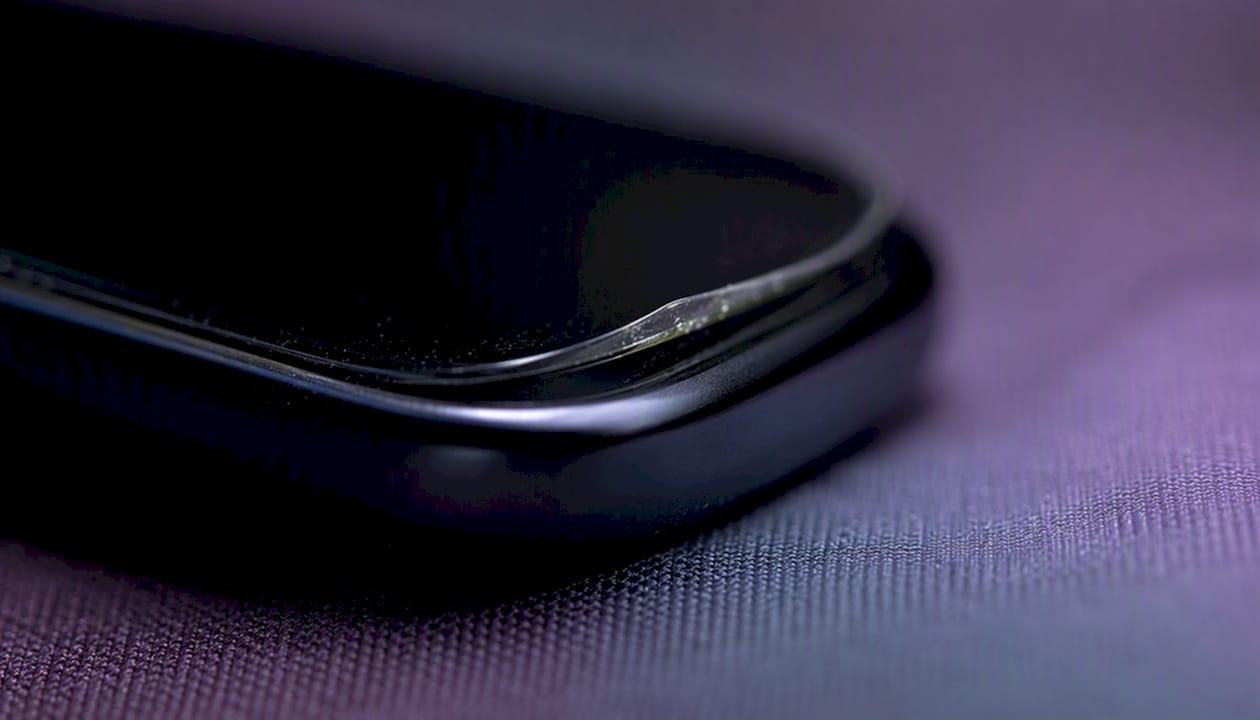
User reports show variable longevity, with some users reporting four months of service before edge peeling and others getting considerably longer. The quality of the adhesive matters as much as the installation. UV adhesives engineered for display lamination are formulated to resist yellowing and delamination, keeping light transmission high over the protector’s life. Cheap adhesives yellow within weeks.
Care checklist
- Clean with a slightly damp microfibre cloth; avoid paper towels, which scratch the oleophobic coating
- Keep alcohol-based cleaners away from the edges, where they can seep under the bond
- Avoid silicone-based screen sprays, which degrade oleophobic coatings over time
- If the protector chips or cracks, replace it promptly; a cracked protector offers reduced protection and sharp edges can cut fingers
Can UV light pass through tempered glass?
Tempered glass blocks most UV radiation. The UV lamp used during installation works because the adhesive is exposed from the side and through the thin glass before it fully cures. Once the protector is bonded, ambient UV from sunlight does not meaningfully penetrate the glass layer to affect the cured adhesive underneath.
One important caution: UV adhesive is for screen protector bonding, not for repairing cracked screens. Repair guides are clear that professional repair or manufacturer replacement is the correct route for cracked screens; UV glue applied to a cracked display is a temporary fix at best and risks further damage.
Removal
Work slowly. If adhesive has seeped into device crevices, take the phone to a professional rather than attempting to flush it out yourself.
Does your case work with a UV tempered glass protector?
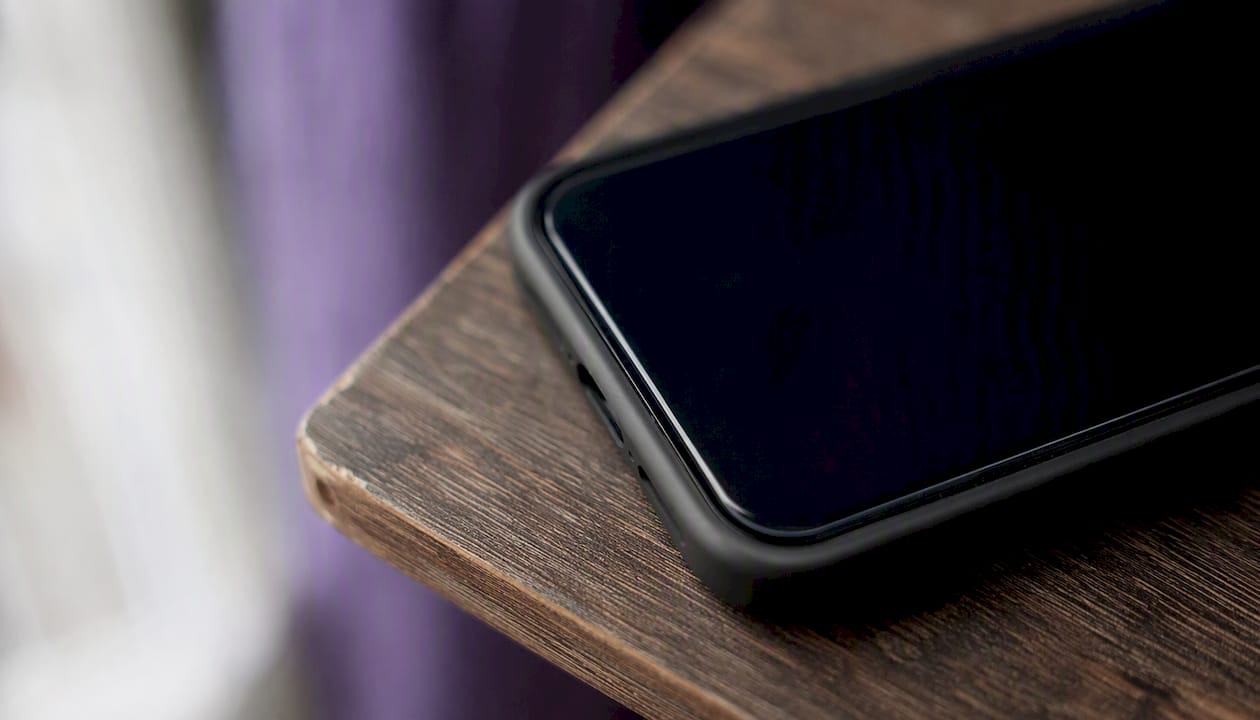
Edge-to-edge protectors and phone cases can conflict, and it is worth checking before you buy.
- Slim cases: usually compatible; the case lip sits slightly above the protector edge without pressing on it
- Bumper cases: check the inner lip height; a deep lip that presses directly onto the protector edge will gradually lift the bond
- Folio and wallet cases: generally fine, as the hinge side does not contact the screen protector
- Thick rugged cases: the most likely to cause problems; a raised inner bezel that grips the screen edge can peel a UV-bonded protector faster than normal wear
The most common fit problem is a case lip that sits directly on the protector’s edge rather than on the phone’s frame. Over time, that pressure creates a stress point and the bond fails at the rim.
Pro Tip: When buying, look for listings that describe the protector as “case-friendly” or specify a slightly reduced coverage area. A protector that stops 0.2–0.3 mm short of the absolute screen edge avoids the case-lip conflict entirely. Check the product notes for “full glue” (adhesive across the whole surface) versus “frame glue” (adhesive only at the edges) — full glue gives better optical results on curved screens.
What should UK shoppers look for when buying?
The UK market has no shortage of UV-cured protector listings, but quality varies considerably. Here is what to check before adding to basket.
Buying checklist
- UV adhesive kit included in the box (not just the glass)
- 9H hardness rating stated explicitly
- Oleophobic coating confirmed on the outer surface
- Device model compatibility listed precisely (not just “fits Samsung S series”)
- UV curing lamp included or specified separately; note whether it is a hand-held LED or a chamber
- Seller returns policy covering installation failures
Spotting low-quality or counterfeit listings
- No adhesive included, or adhesive bottle has no brand or specification
- Hardness listed as “9H+” with no further detail (a marketing claim, not a standard)
- Transparency listed as “99.9%” with no test standard cited
- Suspiciously low price with no model-specific fit information
- Seller has no returns policy or only accepts returns for unopened items
Typical UK price range
UV-cured tempered glass kits in the UK generally run from around £8 to £25 for a consumer kit including adhesive and a basic LED lamp. Professional installation at a phone repair shop adds a service charge on top of the protector cost. Kits at the lower end of that range often include a hand-held LED that delivers an uneven cure; spending a little more for a kit with a better lamp, or opting for professional installation, tends to produce a noticeably better result.
For a broader comparison of tempered glass types and specs, SmartProtectors’ buying guide covers the full range of protector families alongside specification checklists.
Why SmartProtectors is a reliable UK source for UV tempered glass
SmartProtectors is a UK-based e-commerce supplier focused specifically on protective accessories for smart devices, covering screen protectors, lens protectors, cases, and back covers across a wide range of smartphones, tablets, smartwatches, laptops, and earbuds.
- Product range: UV-compatible tempered glass protectors with 9H hardness and oleophobic coating, available for current flagship models and a broad back catalogue
- Hard-to-find models: if your device is not listed, SmartProtectors operates a special-order sourcing service; submit a request and the product is added to the catalogue
- UK shipping: orders dispatched from the UK, with clear delivery timescales
- Customer support: product specification queries answered before purchase; hardness rating and coating details available on request
- Returns: standard UK consumer rights apply; check the site for the current returns window and conditions
When buying, ask the seller to confirm the adhesive specification and whether the UV lamp supplied is sufficient for your screen size. SmartProtectors can advise on which products include a full kit versus glass only, so you know exactly what arrives.
For device-specific options, the IMAK H series for Nothing Phone 4a Pro and the Amorus HD protector for iPhone 17 Pro are examples of the model-specific range available.
When would I actually choose UV-cured glass?
There are two scenarios where I would reach for a UV-cured protector without hesitation: a curved-edge flagship where I want the screen to look and feel as close to bare glass as possible, and a high-value phone I plan to resell, where a lifted edge protector would knock money off the sale price.
Where I would not bother: a flat-screen mid-range phone used mainly at a desk. The installation complexity is real, and the margin for error with the adhesive is not trivial. A standard full-glue tempered glass protector does the job in two minutes with no lamp required.
Situationally:
- Travel: UV-cured protectors hold up well in bags and pockets because the bond does not lift at the edges the way silicone-backed ones do after repeated flexing
- Resale value: a protector with no visible edge lift keeps the screen looking pristine, which matters when selling second-hand
- Heavy scratch risk: the 9H hardness is the same as standard tempered glass, so the UV bond does not add scratch resistance; it adds edge adhesion and optical clarity
SmartProtectors has the UV tempered glass protectors you need
Choosing the right UV-cured protector is straightforward when the product listing is honest about what is included. SmartProtectors carries tempered glass screen protectors with confirmed 9H hardness and oleophobic coatings, listed by specific device model so you are not guessing at fit.
If your model is not in the catalogue, the special-order service means it can be sourced and added without you having to hunt across multiple sellers. Every order comes with standard UK consumer protections, and the support team can confirm product specs before you buy.
Browse the full range or submit a device request at SmartProtectors and get the right protector for your phone without paying over the odds.
Sources
The following references were used as background for this article. Manufacturer and supplier sources reflect technical and commercial guidance; forum sources reflect real user experience, which varies by product and installation quality.
- UV Glue for Screen Protectors: Thin Film Applications Explained
- UV Screen Protectors| Motorola Support IN
- Anyone used a UV glass screen protector? - Mobile Phones & Tablets - TechEnclave