

Liquid screen protectors are not worth using as your primary defence against drops. PCMag’s expert reviewers are clear on this: nano-coatings are too thin to absorb impact, so they cannot replace a physical sacrificial layer. That said, they do have a genuine niche.
- Best for: light scratch resistance and curved or hard-to-fit screens where glass protectors do not align cleanly
- Not for: drop protection or any situation where you need measurable, replaceable impact resistance
- Practical rule: pair a liquid coating with a solid case, or skip it entirely and choose tempered glass if drops are your main concern
Table of Contents
- How does a liquid screen protector compare to tempered glass?
- How do nano liquid screen protectors actually work?
- What are the real pros and cons of liquid protectors?
- How to apply a liquid screen protector correctly
- How long does a liquid screen protector last?
- Will a liquid protector work with your case, sensors and screen type?
- What should UK buyers expect to pay?
- When should you use liquid, and when should you choose tempered glass?
- Key takeaways
- The case for physical protection is stronger than the marketing suggests
- SmartProtectors: physical protection that actually shows up when it matters
- Sources and further reading
How does a liquid screen protector compare to tempered glass?
The table below covers the decisions that actually matter at the point of purchase.
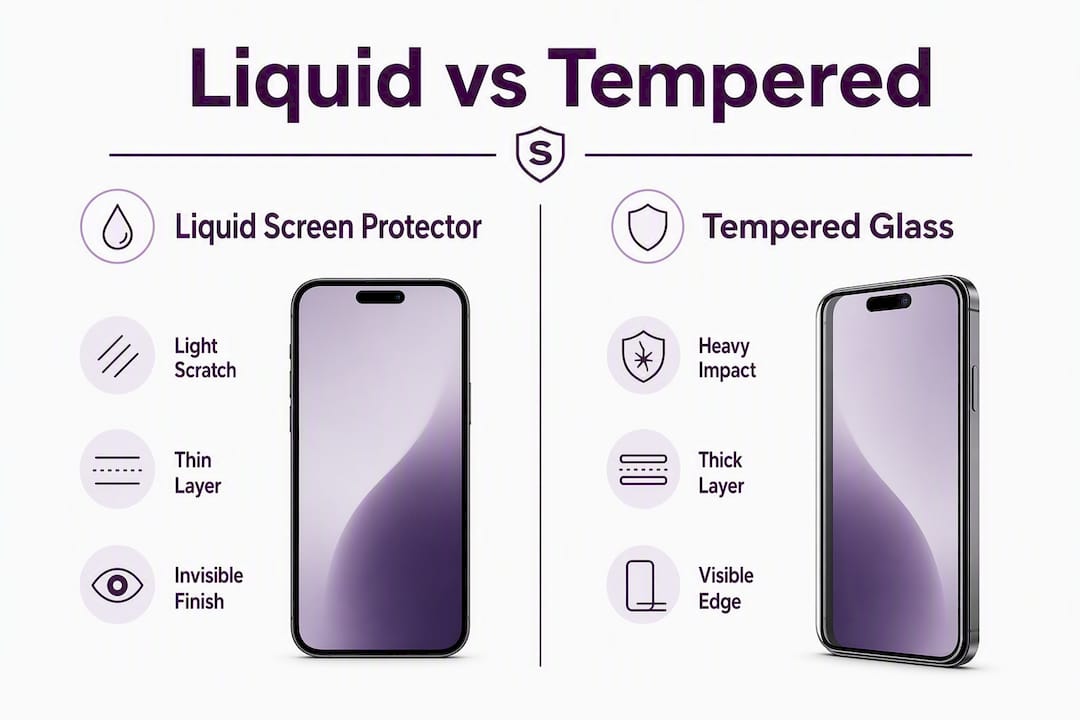
| Dimension | Liquid (nano) coating | Tempered glass |
|---|---|---|
| Scratch protection | Moderate (surface hardening) | Strong (physical barrier) |
| Impact protection | Minimal | Reliable sacrificial layer |
| Feel and appearance | Invisible, preserves original screen | Slight added thickness; may alter glare |
| Bulk and case fit | None | Minimal; check edge clearance |
| Replaceability | Cannot be removed; wears off | Peel off and replace when cracked |
| Installation difficulty | Easy wipe-on; no alignment needed | Moderate; alignment critical |
| Longevity | Months (varies with use) | Over a year or until cracked |
| Typical UK price | Moderate cost per kit | Moderate cost per unit |
The dominant trade-off is straightforward: liquid coatings give you an invisible finish that preserves the original screen feel, while tempered glass gives you a measurable, replaceable layer that actually cracks before your screen does. One is aesthetic; the other is structural.
- Heavy dropper or clumsy commuter: choose tempered glass every time
- Curved-screen owner (Samsung Galaxy S-series, for example): liquid or a purpose-cut curved glass are your realistic options
- Style-first user who rarely drops their phone: liquid works, but pair it with a case
How do nano liquid screen protectors actually work?
The short answer: a liquid protector bonds chemically to your screen’s glass surface, forming a layer measured in nanometres rather than millimetres.
Most formulations use silicon dioxide (SiO₂), essentially microscopic glass particles suspended in a liquid carrier. When you wipe the solution across your screen and allow it to cure, those particles settle into the micro-pores of the glass and harden, increasing surface hardness and adding hydrophobic and oleophobic properties. The result is a coating you cannot see or feel, but one that does make the surface marginally harder and more resistant to fingerprints.
Tempered glass works on an entirely different principle. It is heat-treated under compression, typically rated at 9H hardness, and sits as a distinct physical sheet above your screen. When it takes a hard knock, it absorbs and distributes the energy, often cracking itself rather than your display. That crack is the point: it is a sacrificial layer you can peel off and replace. A nanometre-thin liquid coating has no such mass to absorb energy, so deep scratches or impacts pass straight through to the original glass.
Think of it as the difference between waxing a car bonnet and fitting a bull bar. Both add some surface protection; only one stops a collision.
What are the real pros and cons of liquid protectors?
Liquid coatings make most sense for owners who prioritise screen aesthetics, use curved-display devices, or already have strong case protection in place.
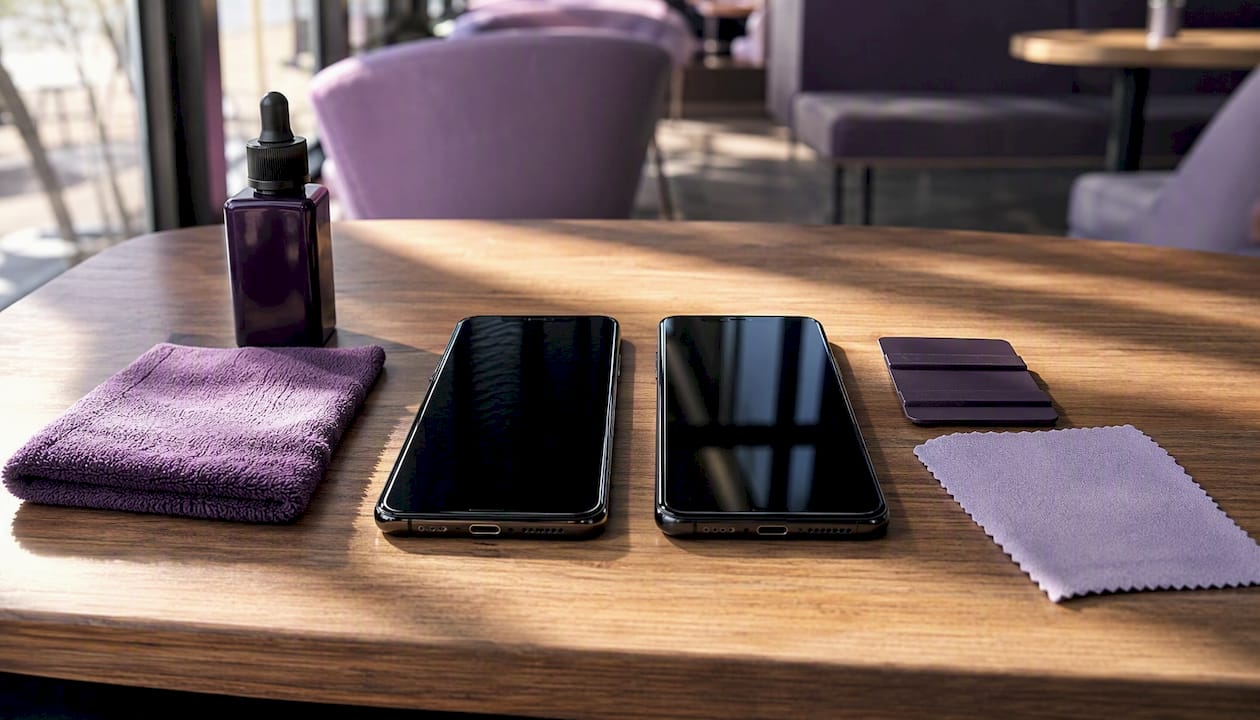
The genuine advantages are few but real. Because there is no added physical layer, touch sensitivity and under-display sensors remain completely unaffected. Face ID, under-display fingerprint readers, and stylus precision all work exactly as before. On curved-edge phones, where glass protectors often leave exposed strips along the sides, a liquid coating covers the entire surface without bubbling or lifting. Manufacturers also advertise reduced smudging and a smoother swipe feel from the oleophobic surface treatment.
The limitations are harder to ignore. A liquid coating cannot be peeled off when it wears out; it simply degrades invisibly over time. You cannot tell by looking whether you still have meaningful protection. And for impact, the coating adds almost nothing: a phone dropped face-down onto concrete will behave almost identically with or without a nano coating applied.
Realistic use cases:
- A commuter who keeps their phone in a dedicated pocket and rarely drops it
- An owner of a curved-screen phone where glass protectors do not fit cleanly
- A photographer who wants nothing between the camera lens and the image
- Anyone already using a robust, edge-protecting case and wants a secondary surface treatment
Pro Tip: Use a liquid coating as an adjunct, not a sole solution. Apply it to a device already inside a case with raised edges, or layer it under a PET film protector on a curved screen. That combination gives you the edge coverage of liquid plus the replaceable surface of film.
How to apply a liquid screen protector correctly
Clean thoroughly, apply evenly, cure fully, then verify. That four-step sequence is where most people go wrong, usually at step one.
- Clean the screen with the alcohol wipe included in the kit. Follow immediately with a lint-free microfibre cloth, then use the dust-removal sticker (most kits include one) to lift any remaining fibres. Any dust left under the coating will be there permanently.
- Apply the solution using the swab or applicator provided. Work in small circular motions from the centre outward, covering the full screen surface including curved edges. Use the entire applicator for a single device; do not save half for later.
- Cure at room temperature in a dry, dust-free area. Most manufacturers specify 10–15 minutes before touching the screen. Avoid applying in humid conditions or direct sunlight, both of which can interfere with bonding.
- Verify the application by running a clean fingernail lightly across the surface: a properly cured coating feels slightly harder and smoother than bare glass. Check touch response and Face ID or fingerprint unlock immediately after curing.
One important note on safety: keep the liquid away from your eyes and skin during application, and follow any PPE guidance on the packaging. Do not wipe the screen aggressively during the cure window; that disrupts the molecular bonding before it completes.
PCMag notes that there is no reliable visual check to confirm even coverage or remaining thickness after everyday use, which is why step four matters: it is the only practical confirmation you have that the coating took.
How long does a liquid screen protector last?
Expect a credible liquid coating to last several months under normal use before it degrades noticeably. That range is wide because friction from fingers, pockets and regular cleaning all accelerate wear, and there is no visible indicator when protection drops below a useful level.
Maintenance and replacement triggers:
- Clean with mild soap and water or a damp microfibre cloth; avoid abrasive cloths or alcohol-based cleaners after the initial application, as these strip the coating faster
- Reapply when you notice reduced smoothness on swipes, increased fingerprint smudging, or visible micro-scratches on the surface
- Most kits cover one to four devices per bottle; check coverage before buying if you want to reapply on schedule
The invisible wear-off is the biggest practical problem with liquid protectors. A cracked tempered glass sheet tells you immediately it needs replacing. A degraded nano coating tells you nothing, so you are left guessing whether you still have any meaningful surface hardening in place.
Will a liquid protector work with your case, sensors and screen type?
Generally yes for sensors, with caveats for special coatings and screen types.
- Under-display fingerprint readers and Face ID: liquid coatings do not interfere with either, since no physical layer sits above the sensor
- Oleophobic factory coating: applying a liquid protector over a phone’s existing oleophobic layer is usually fine; the nano coating bonds to the glass beneath and may actually restore oleophobic properties as the factory coating wears
- Curved OLED displays: liquid coatings are one of the few options that cover curved edges cleanly without lifting; no impact on colour accuracy or HDR performance
- Polarised sunglasses: unlike some glass protectors, liquid coatings do not cause rainbow glare when viewed through polarised lenses
- Cases: because liquid coatings add no thickness, there are no edge-clearance or case-fit issues
One limitation is permanent: a liquid coating cannot be peeled off. If you later decide you want a physical glass protector, the nano layer will simply wear away underneath it over time. But if you apply a glass protector on top of a fresh liquid coating, the adhesive may not bond correctly. Apply one or the other, not both simultaneously.
For an overview of all protector types and how they compare, SmartProtectors’ guide covers the full range.
What should UK buyers expect to pay?
A credible liquid kit in the UK typically costs £5–£15 and covers one to four devices depending on the brand. That is comparable to an entry-level tempered glass unit, but the comparison shifts when you factor in reapplication: glass is a one-off purchase until it cracks, while liquid requires periodic top-ups.
UK buying checklist:
- Kit contents: look for alcohol wipes, a lint-free cloth, a dust-removal sticker, and a dedicated applicator swab
- Coverage claim: check whether the kit covers one device or several; some budget kits only cover a single application
- Safety markings: prefer products with CE or UKCA markings and a clear ingredients list
- Returns policy: buy from a retailer with a straightforward returns process; liquid protectors cannot be tested without applying them
- Postage and warranty: check delivery timescales and whether the seller offers a satisfaction guarantee
For measurable impact protection, a SmartProtectors tempered-glass option is the stronger buy. If you are on a curved-screen device or want an invisible surface treatment as a secondary layer, a liquid kit is a reasonable low-cost addition.
When should you use liquid, and when should you choose tempered glass?
Tempered glass is the right default for most people. It provides measurable, replaceable impact protection that liquid coatings simply cannot match, and expert consensus from PCMag and Rokform consistently backs that position.
- If you drop your phone regularly: tempered glass, full stop. The sacrificial layer is the entire point
- If you own a curved-screen phone and aesthetics matter: liquid coating or a purpose-cut curved glass; pair either with a case for any real drop protection
- If you want the cleanest possible screen feel and already use a protective case: liquid works as a surface treatment; just reapply every few months
The strongest protection strategy for most UK buyers is a quality tempered glass protector paired with a case that has raised edges. Liquid coatings are a useful adjunct for specific situations, not a replacement for that combination.
Key takeaways
Tempered glass provides measurable, replaceable impact protection that liquid nano-coatings cannot replicate, making it the right default for most UK buyers.
| Point | Details |
|---|---|
| Liquid coatings are not standalone protection | They resist light scratches but offer minimal impact defence; pair with a case or choose tempered glass. |
| Nano coatings wear off invisibly | Expect two to six months of useful life; reapply when smoothness or oleophobic feel degrades. |
| Best use case is curved screens | Liquid covers curved edges cleanly where glass protectors lift or leave gaps. |
| Tempered glass is sacrificial and replaceable | A 9H-rated glass sheet cracks before your screen does and can be swapped out immediately. |
| SmartProtectors for physical protection | SmartProtectors’ tempered-glass and PET film range gives UK buyers measurable, replaceable protection across a wide range of devices. |
The case for physical protection is stronger than the marketing suggests
There is a pattern worth naming: liquid screen protectors are marketed with impressive-sounding language (nano-technology, SiO₂ molecular bonding, military-grade hydrophobic surface) that makes them sound like a serious upgrade. For scratch resistance and fingerprint reduction, they deliver something real. For the thing most people actually worry about, which is dropping their phone on a hard floor, they deliver almost nothing.
The invisibility that makes liquid coatings appealing is also their core weakness. You cannot see whether the coating is still working. You cannot peel it off when it fails. You cannot tell, after six months of pocket friction, whether you have 80% of the original protection or 10%. A cracked tempered glass sheet, by contrast, is a clear, honest signal: replace me now.
The right mental model is not “liquid vs glass” but “surface treatment vs structural protection.” A liquid coating is closer to a screen-cleaning product with lasting benefits than it is to a protector. Used with that expectation, it is genuinely useful. Used as a substitute for a physical layer on a phone you drop regularly, it will let you down without warning.
For most people reading this, the practical answer is a tempered glass protector from SmartProtectors, with a case that has raised edges, and the knowledge that the glass is doing the real work.
SmartProtectors: physical protection that actually shows up when it matters
SmartProtectors stocks a range of physical screen protectors built for measurable, day-to-day impact resistance across smartphones, tablets, smartwatches, and laptops. The range includes options for common flagship devices and harder-to-find models alike.
Key products worth considering:
- SmartProtectors full coverage shockproof tempered glass for Samsung Galaxy S25 and S24: a 9H-rated sacrificial layer with full-screen coverage
- SmartProtectors Anti Glare PET Screen Protector for iPhone 16 Pro Max: matte finish, reduced glare, physical film protection
- SmartProtectors acrylic glass HD screen protector for Huawei Watch Fit: precision-cut for smartwatch displays
- IMAK tempered glass lens protector for OnePlus 10 Pro: camera lens protection with acrylic cap
Can’t find your device model? Submit a request and SmartProtectors will source and add it to the catalogue. Browse the full range at SmartProtectors.eu and find the right protector for your device today.
Sources and further reading
Research and expert opinion informing this article draw from the following sources. Readers are encouraged to check primary sources for the most current product specifications and testing methodology.
- PCMag: What Kind of Screen Protector Should I Get for My Phone? — expert review consensus on tempered glass vs liquid protectors for impact and scratch protection
- INAIRSPACE: Tempered Glass vs Liquid Screen Protector — technical comparison of SiO₂ nano-coatings and physical glass layers, including replaceability and wear characteristics
- The New Handset: Screen Protectors — Tempered Glass vs Liquid vs Film — user experience comparison covering touch sensitivity, sensor compatibility and curved-screen performance
- SmartProtectors blog: types of screen protectors and how to choose — overview of protector categories for UK buyers
- SmartProtectors blog: how to choose the perfect tempered glass — selection guidance for physical glass protectors