

For most UK smartphone users, a ceramic screen protector is the smarter choice if you own a curved-display phone, want a cover that won’t shatter visibly after a corner drop, or need a matte finish for outdoor use. If maximum scratch resistance and a glass-like feel matter more to you, tempered glass still has the edge. Before you buy either, check three things: whether your device model is listed, whether the protector works with your case, and what the warranty covers.
Key takeaways
Ceramic screen protectors are the better choice for curved displays and users who want shatter-resistant protection; tempered glass remains the stronger option for maximum scratch resistance and a glass-like touch feel.
| Point | Details |
|---|---|
| Ceramic suits curved screens | Flexible construction hugs curved and edge displays better than rigid tempered glass. |
| Tempered glass wins on scratch feel | Glass protectors offer crisper touch response and are often harder at the surface. |
| 9H is a pencil-hardness rating | It measures surface scratch resistance only, not impact absorption or drop performance. |
| Always verify device model fit | Check the exact model number, case compatibility, and in-display fingerprint support before buying. |
| SmartProtectors for device-specific options | SmartProtectors matches protectors to exact device models and offers a sourcing service for unlisted devices. |
Table of Contents
- What is a ceramic screen protector, and how does it differ from glass?
- Ceramic vs tempered glass: which one actually protects better?
- How to choose a ceramic screen protector: the buyer’s checklist
- How to install and care for a ceramic protector so it lasts
- How to read specs and testing claims on product pages
- Where to buy ceramic screen protectors in the UK
- Why SmartProtectors: range, fit service, and guarantees
- A short perspective on ceramic protectors in real-world use
- SmartProtectors’ ceramic and hybrid screen protector range
- Sources
What is a ceramic screen protector, and how does it differ from glass?
The term “ceramic screen protector” covers two distinct constructions, and knowing which one you’re looking at changes how you should evaluate it.
The first type is a ceramic film: a thin, flexible polymer substrate embedded with nano-ceramic particles. It behaves more like a skin than a pane of glass, bending slightly under pressure rather than snapping. The second is a glass-ceramic hybrid: a rigid or semi-rigid sheet where ceramic compounds are fused into or layered onto a glass base. Both constructions trade a degree of surface hardness for better shatter resistance compared with standard tempered glass. As INAIRSPACE explains, ceramic protectors are hybrid constructions that combine flexible substrates with ceramic particles or coatings, offering better edge coverage and resistance to shattering.
Common finishes and features you’ll see on product listings:
- Clear/transparent: maximum colour accuracy and brightness
- Matte/anti-glare: reduces reflections outdoors, slightly softens contrast
- Oleophobic coating: resists fingerprint smudges; quality varies significantly between brands
- Blue-light filter: tints the display slightly; useful for night-time use
- Flexible edge design: allows the film to conform to curved or waterfall displays
The flexibility of ceramic films is also why they’re widely recommended for curved and edge displays, where rigid tempered glass often lifts at the edges or leaves uncovered strips along the curve.
Ceramic vs tempered glass: which one actually protects better?
The honest answer is that it depends on what you’re protecting against. Small-scale comparative testing across a limited sample of smartphones found ceramic protectors can perform well on curved displays with fewer visible cracks after certain corner drops, while tempered glass generally provides sharper touch response and clarity in many models tested.
| Feature | Ceramic protector | Tempered glass |
|---|---|---|
| Scratch resistance | Good (typically 9H pencil hardness) | Very good (typically 9H, often harder surface) |
| Edge/chip behaviour | Tends to flex rather than shatter visibly | Can crack or chip at edges on impact |
| Curved screen fit | Excellent; flexible film hugs edges | Often poor; rigid glass lifts at curves |
| Display clarity | Good; matte options slightly reduce contrast | Excellent on clear variants |
| Touch sensitivity | Slightly softer feel; varies by brand | Crisp, glass-like response |
| Thickness | Typically 0.2 mm (film); varies for hybrid | Typically thin layers around 0.2 mm thick |
| Case compatibility | Generally good; flexible edge helps | Can conflict with raised-edge cases |
| Price range (UK) | Typically mid to premium pricing in the UK market | A range of pricing options available |
| Warranty/replacement | Varies; check per listing | Varies; check per listing |
Pick ceramic if: you have a curved or waterfall display (Samsung Galaxy S-series, Pixel 9 Pro), you want a matte finish, or you’d rather avoid the spiderweb-crack look after a drop.
Pick tempered glass if: you prioritise the sharpest possible touch feel, prefer a glass surface underhand, or need the most scratch-resistant surface for a flat-screen device. For a detailed look at full-coverage glass options, the IMAK Pro series for iPhone 17 Pro Max shows how high-coverage tempered glass handles flagship flat screens.
How to choose a ceramic screen protector: the buyer’s checklist
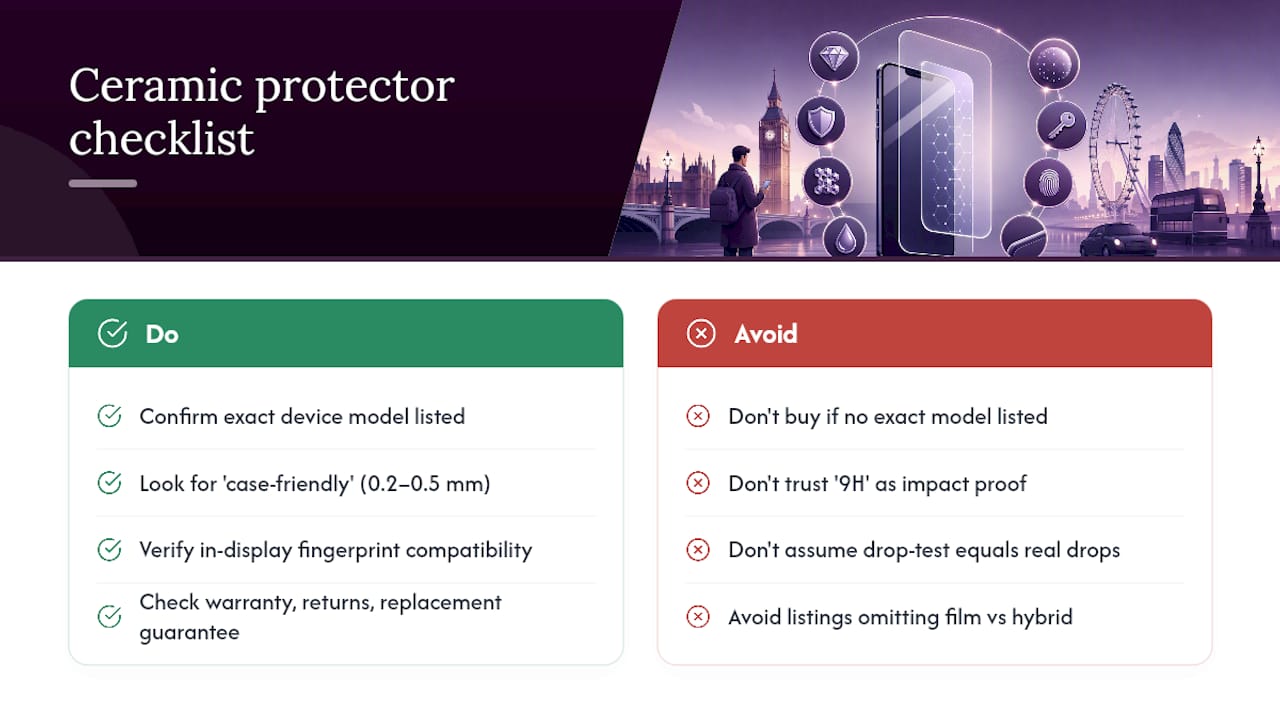
Product pages for ceramic protectors vary wildly in the detail they provide. Here’s what to check before you commit.
Device model compatibility is the first filter. A protector listed for “Samsung Galaxy S25” may not fit the S25 Ultra, which has different dimensions and a more pronounced curve. Always look for the exact model number in the product title or compatibility list.
Edge coverage vs case compatibility is a genuine tension. Full-edge ceramic films offer better protection but can bunch under thick cases. Look for “case-friendly” or “case-compatible” in the description, which usually means the film stops 0.2–0.5 mm short of the very edge.
Hardness claims need context. A “9H” rating refers to pencil hardness, not the Mohs mineral scale. It tells you the surface resists scratching from a 9H pencil, which is useful as a rough comparator between products, but it says nothing about impact absorption or how the protector behaves when dropped on concrete.
Finish: clear films preserve colour accuracy; matte films cut glare outdoors but soften the image slightly. If you use your phone in direct sunlight regularly, matte is worth considering.
Drop-test claims on product pages are almost always conducted in controlled lab conditions. A “1.5 m drop test” typically means a flat drop onto a padded surface, not a corner drop onto tarmac.
Warranty and returns matter more than most buyers realise. A protector with a 30-day returns window and a replacement guarantee costs you nothing if it fails early; one without leaves you buying again.
Installation method: most ceramic films come with a dry-adhesive system and an alignment frame. Wet-adhesive installs (common on some hydrogel films) are rarer for ceramic and require more drying time.
Red flags to avoid: any listing that says “ceramic” without specifying whether it’s a film or glass-ceramic hybrid; no device model listed (just “fits most phones”); no returns or warranty information.
Pro Tip: For in-display fingerprint readers (common on Samsung and OnePlus flagships), check the product description explicitly for “in-display fingerprint compatible” or “ultrasonic fingerprint compatible.” A ceramic film that’s too thick or has the wrong adhesive layer can block the sensor entirely. If the listing doesn’t mention it, assume it’s untested.
How to install and care for a ceramic protector so it lasts
A poor installation causes more early failures than the protector itself. Take ten minutes and do it properly.
Step-by-step installation
- Clean the screen thoroughly. Use the alcohol wipe supplied, then the microfibre cloth. Work in a low-dust environment (a bathroom after a hot shower works well).
- Remove any existing protector and clean again. Old adhesive residue will cause bubbles.
- Align before you peel. If an alignment frame is supplied, fit it to the phone first and test the position dry before removing the backing.
- Peel the backing slowly at a low angle and lower the film onto the screen from one edge, letting it settle under its own weight.
- Press out bubbles from the centre outward using the squeegee card. Small air bubbles near the edges usually disappear within 24–48 hours as the adhesive settles.
- Leave it to cure for at least an hour before fitting a case.
Product listings from specialist retailers often highlight EasyAligner-style frames and case-friendly designs specifically to reduce edge lift on curved screens, so check whether your chosen protector includes one.
Troubleshooting
- Dust under the film: use the sticky tab (usually included) to lift the edge gently and remove the particle before re-pressing.
- Persistent bubbles after 48 hours: the adhesive may not have bonded fully; press firmly with the squeegee card again, or the surface may have had residue.
- Edge lift on curved screens: a thin bead of UV adhesive or a case that holds the edge down can help; some films simply aren’t designed for your specific curve radius.
When to replace it
Replace your ceramic protector when you notice: a build-up of micro-scratches that affect screen visibility; touch sensitivity issues (the film may have delaminated slightly); peeling edges that won’t re-adhere; or any crack that reaches the display area. Film-type ceramic protectors typically last 12–24 months under normal use, though this varies with how much grit and sand the surface encounters.
How to read specs and testing claims on product pages
Marketing language on screen protector listings can obscure more than it reveals. Here’s a quick decoder.
Mohs hardness vs pencil hardness
The Mohs scale measures mineral hardness from 1 (talc) to 10 (diamond). A phone screen’s glass sits around 6–7 on this scale. The 9H claim you see on most protectors refers to the pencil hardness scale, a completely different system used in coating and paint testing. A 9H pencil hardness means the surface resists scratching from a 9H drawing pencil. It’s a useful relative comparator between products, but it doesn’t translate directly to Mohs values or predict how the protector handles a drop. INAIRSPACE’s buying guide notes that 9H claims help compare surface hardness but don’t fully describe impact absorption or real-world durability.
| Claim | What it actually tests | What it doesn’t tell you |
|---|---|---|
| 9H hardness | Pencil-hardness scratch resistance | Impact absorption, drop behaviour |
| Drop test (e.g. 1.5 m) | Flat or controlled drop in lab conditions | Corner drops, real-world surfaces |
| Anti-shatter | Protector holds together on impact | Whether the phone screen underneath survives |
| Oleophobic coating | Initial fingerprint resistance | How long the coating lasts with daily use |
How to weigh manufacturer drop-test claims
Independent testing shows that real-world results vary considerably: some cheaper tempered glass outperformed premium ceramic in specific drop tests, which illustrates that construction quality and test conditions matter more than the material label alone. When evaluating a product page, look for: stated test conditions (drop height, surface type, number of drops), third-party or independent test reports, and customer reviews that specifically mention drop incidents rather than just installation experience.
Where to buy ceramic screen protectors in the UK
Ceramic protectors appear across several retail channels in the UK. Mainstream carriers and electronics retailers stock them for flagship models; specialist accessory stores and direct e-commerce sites tend to offer wider model coverage and better returns policies.
Price bands to expect in the UK:
- Entry level (£8–£12): typically ceramic film, basic packaging, limited warranty
- Mid-range (£12–£20): glass-ceramic hybrid or higher-quality film, alignment frame included, 30-day returns common
- Premium (£20–£35+): branded glass-ceramic, independent test claims, extended warranty or replacement guarantee
UK retail listings confirm that ceramic protectors are available for current flagship models from major carriers and specialist stores. PanzerGlass, for example, lists ceramic screen protectors for current iPhone models via UK retailers, which gives a useful benchmark for mid-to-premium pricing in the UK market.
Buying direct vs through a marketplace: direct purchase from a specialist retailer or the manufacturer’s own site usually gives you clearer warranty terms and a simpler returns process. Marketplace listings can be cheaper but warranty claims often go through a third-party seller rather than the brand, which slows resolution.
For less common device models (older flagships, mid-range Android, niche brands), specialist e-commerce sites with a sourcing service are often the only reliable route to a confirmed-fit protector.
Why SmartProtectors: range, fit service, and guarantees
SmartProtectors covers screen protectors, camera lens protectors, cases, and back covers across smartphones, tablets, smartwatches, laptops, and earbuds, including models that mainstream retailers don’t stock.
Key reasons to buy through SmartProtectors:
- Device-specific matching: products are listed by exact device model, reducing the risk of buying a protector that doesn’t fit your screen dimensions or curve radius.
- Sourcing service for rare models: if your device isn’t in the catalogue, you can submit a request and SmartProtectors will source and add it.
- Warranty and returns: SmartProtectors states it offers warranty and returns policies for buyers purchasing via its site, giving you a clear route if a product doesn’t perform as described.
- Range depth: from clear tempered glass to ceramic films and matte finishes, the catalogue covers the main protector types discussed in this article.
For flagship iPhone users, the IMAK Pro series for iPhone 15 Pro Max is a good example of how model-specific pages show installation aids and case-compatibility notes in detail.
A short perspective on ceramic protectors in real-world use
The gap between what ceramic protectors promise and what they actually deliver in daily use is narrower than the marketing suggests, but it’s real. On curved screens, the flexibility advantage is genuine: a ceramic film that hugs a Samsung Galaxy edge simply sits flatter and stays adhered longer than most rigid glass alternatives. That’s not a small thing if you’ve ever peeled a lifting glass protector off a curved display after three weeks.
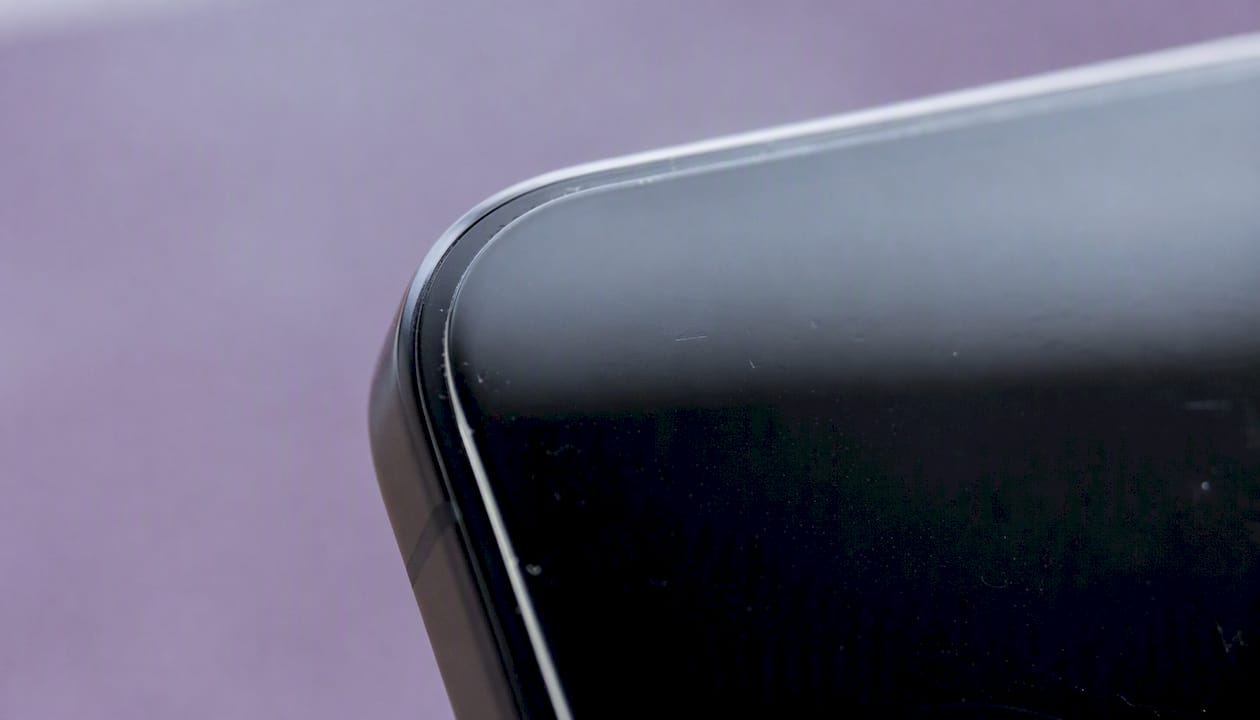
Where ceramic falls short is surface feel. There’s a slight softness to the touch on most ceramic films that glass users notice immediately. It’s not unpleasant, but if you’re used to the crisp response of bare glass or a high-quality tempered protector, the adjustment takes a few days. On matte variants, the texture is more pronounced.
The 9H hardness claim deserves more scepticism than it usually gets. Both ceramic and tempered glass products carry it, which makes it nearly useless as a differentiator. What matters more is the construction quality of the specific product and whether the oleophobic coating holds up after a few months of daily use. Independent test reports and verified customer reviews that mention real drop incidents are worth far more than a hardness number on a box.
This is an editorial observation based on product research and published test reports, not a controlled lab test. For lab-grade evidence, consult independent testing sources such as those linked in the further reading section below.
SmartProtectors’ ceramic and hybrid screen protector range
Choosing the right protector is straightforward when the product is matched to your exact device. SmartProtectors lists screen protectors by model, covers an unusually wide range of devices including hard-to-find models, and backs purchases with warranty and returns policies so you’re not left out of pocket if something goes wrong.
Whether you’re after a flexible ceramic film for a curved display or a full-coverage glass protector for a flat screen, you can check device-specific options and availability directly on the SmartProtectors site. If your model isn’t listed, the sourcing request service means it can be added. Browse the full range and find your device’s match at SmartProtectors.
Sources
- Ceramic or Tempered Glass Screen Protector: Which One Should You Choose? – INAIRSPACE
- Tempered Glass Vs Ceramic Glass: Protect Your Phone Better