

Sapphire protectors give you the best scratch resistance money can buy for a phone or watch, rated 9 on the Mohs scale against roughly 6 to 7 for tempered glass. The catch is brittleness: sapphire chips and cracks more readily on a hard drop than engineered glass does. It suits people who want a pristine surface for years on a premium phone, watch, or camera lens rather than heavy drop protection.
TL;DR:
- Sapphire protectors excel at resisting scratches and wear but are more prone to chipping and cracking from drops due to their rigidity.
- The main advantage of sapphire is its Mohs 9 hardness, which surpasses tempered glass’s 6 to 7 but does not improve impact toughness.
- Coatings on sapphire protectors wear before the substrate, making the quality of coating placement and bonding critical to durability.
- Sapphire is most beneficial for devices exposed to constant abrasion, like watch faces or camera lenses, rather than devices at high risk of drops.
- Price premium for sapphire is justified mainly when scratch resistance outweighs impact protection needs, as it provides limited drop resilience.
Table of Contents
- What sapphire screen protectors are and why hardness matters
- Sapphire vs tempered glass: the trade-offs that actually decide your purchase
- Who actually benefits from a sapphire screen protector?
- How to choose a sapphire screen protector without guessing
- Why you can trust this guide
- Scratch resistance and impact toughness pull in opposite directions
- What the sapphire premium actually buys you
- Chipped edges and cracked coatings: how sapphire protectors actually fail
- Where sapphire earns its price, and where it doesn’t
- Finding the right protector for your device
- Sources
What sapphire screen protectors are and why hardness matters
Sapphire used in screen protection is synthetic corundum, essentially crystallised aluminium oxide grown in a lab rather than mined from rock. It’s the same material Citizen Watch uses in its premium watch crystals, chosen because it holds its finish under constant contact with sleeves, desks, and keys.
Hardness on the Mohs scale measures one thing only: how resistant a material is to being scratched by something harder. It says nothing about how well that material survives a shock. Sapphire sits at 9, second only to diamond at 10, while tempered glass typically lands around 6 to 7.
Sapphire’s hardness at a glance:
- Diamond (Mohs 10): the only material that reliably scratches sapphire in normal use
- Sapphire (Mohs 9): resists keys, coins, sand, and most quartz-based grit
- Tempered glass (Mohs 6 to 7): can be marked by quartz sand, some ceramics, and harder metals
Pro Tip: If you’ve ever pulled a phone from a pocket full of loose change and found faint scratches the next day, that’s tempered glass losing to everyday grit. Sapphire shrugs off almost all of it.
Toughness is the property people confuse with hardness, and it’s the opposite trait in practice. A material can be extremely hard and still shatter on impact, which is exactly what happens with sapphire when a phone lands corner first on concrete. Nothing short of diamond will scratch it, but a sharp enough impact can still crack it clean through.
Sapphire vs tempered glass: the trade-offs that actually decide your purchase
The Mohs numbers tell only half the story. Tempered glass wins on flexibility. It’s engineered to absorb shock by bending microscopically and distributing force across the panel, which is why it tends to survive drops that would fracture a stiffer, harder material. Sapphire has almost no give, so the same drop that leaves tempered glass intact can chip or crack sapphire.
Where each material wins:
- Scratch resistance: sapphire, decisively, at Mohs 9 versus 6 to 7
- Drop and impact survival: tempered glass, because flex beats rigidity in a fall
- Optical clarity: roughly equal when both are properly polished
- Edge protection: varies by product, not by material, so check this separately
Coatings complicate the comparison further. Most sapphire and glass protectors carry an anti-reflective or oleophobic coating on top of the base material, and that coating wears before the substrate does. You can end up with visible fine scratches on a sapphire protector that’s technically undamaged underneath, because the coating itself sits well below Mohs 9.
Pro Tip: Ask whether the anti-reflective layer sits on top of the sapphire or is baked into it. A coating applied as a thin external film wears faster and shows scratches sooner than one fused during manufacturing.
Thickness plays into both scratch and impact behaviour too. A thicker sapphire pane resists cracking better but adds weight and can dull touch sensitivity slightly, so the sweet spot varies by device and use case rather than following a single rule.
Who actually benefits from a sapphire screen protector?
Sapphire isn’t the right call for every device or every owner. It rewards specific habits and specific devices far more than others.
- Watch wearers. A watch face gets far more abrasion over a year than a phone screen does, brushed against sleeves, desks, and door frames constantly, which is why smartwatch screen protectors worn daily benefit from sapphire’s scratch resistance. Sapphire crystals dominate the premium watch market for exactly this reason, and the same logic applies to smartwatch screen protectors worn daily.
- Owners of premium phones who rarely drop them. If your phone lives in a pocket or bag more than it gets dropped on tile, scratch resistance matters more day to day than drop survival.
- Camera lens protection. A scratched lens cover degrades every photo you take, permanently, whereas a scratched screen is mostly cosmetic. Sapphire’s surface hardness pays off here more visibly than almost anywhere else.
- Active users, frequent droppers, and tight budgets. If your phone regularly meets pavement, or you simply don’t want to pay a premium for a feature that won’t help you, tempered glass or hydrogel remains the more sensible pick.
Curved displays add one more wrinkle: sapphire is harder to form around a curve without adding thickness at the edges, so fit and compatibility need checking model by model before you buy.
How to choose a sapphire screen protector without guessing
Start with coverage. Full-surface protectors bond edge to edge, while windowed designs leave a border exposed. Full coverage protects more of the screen but needs precise bezel bonding to avoid lifting at the corners, which is where most installation complaints originate.
Thickness is your second decision. Thinner sapphire preserves touch sensitivity and sits closer to the way the screen feels bare, but adds some chip risk at the edges. Thicker panels resist cracking better but can interfere with fingerprint sensors or under-display cameras if the seller hasn’t accounted for it.
What to check before buying:
- Confirm the coating sits on top of or fused into the sapphire, not just advertised generically
- Ask whether the installation kit includes an alignment frame or dust-free application tool
- Check the warranty terms for cracked or chipped units, since sapphire’s brittleness makes this the most common failure claim
- Confirm exact model compatibility, particularly for curved edges or sensor cutouts
Pro Tip: If a listing doesn’t specify Mohs hardness or coating placement, ask before you buy. Vague “premium glass” language on a product page is usually a sign the seller doesn’t know either.
Pricing and availability vary a lot by seller and model, so checking current listings against your specific device before committing is worth the five minutes it takes.
Why you can trust this guide
This article was written by Dian for SmartProtectors, drawing on published material science comparisons and independent reviews rather than manufacturer marketing claims, to give a straight answer on where sapphire earns its price and where it doesn’t.
SmartProtectors stocks screen protectors, lens protectors, cases, and back covers across a wide range of phones, tablets, smartwatches, laptops, and earbuds, including models that are hard to find elsewhere. Among the catalogue sits full coverage tempered glass built with a dust-free installation tool, designed for exactly the fit and bonding concerns covered above. If your device isn’t listed, SmartProtectors takes sourcing requests and adds new products to the catalogue.
Scratch resistance and impact toughness pull in opposite directions
The single most useful thing to understand about sapphire is that its two headline properties trade off against each other rather than reinforcing one another. Higher hardness means the crystal lattice resists being gouged by anything softer than itself. It does not mean the material absorbs energy well when struck.
Tempered glass is manufactured specifically to flex and distribute impact force, which is a toughness property, not a hardness one. That’s why a screen protector can score lower on the Mohs scale and still survive a fall that would fracture a harder material outright. Reviewer testing bears this out: sapphire consistently resists day-to-day scratching better, but drop survival doesn’t improve in step with hardness, and in some cases sapphire fractures where tempered glass would have flexed and held.
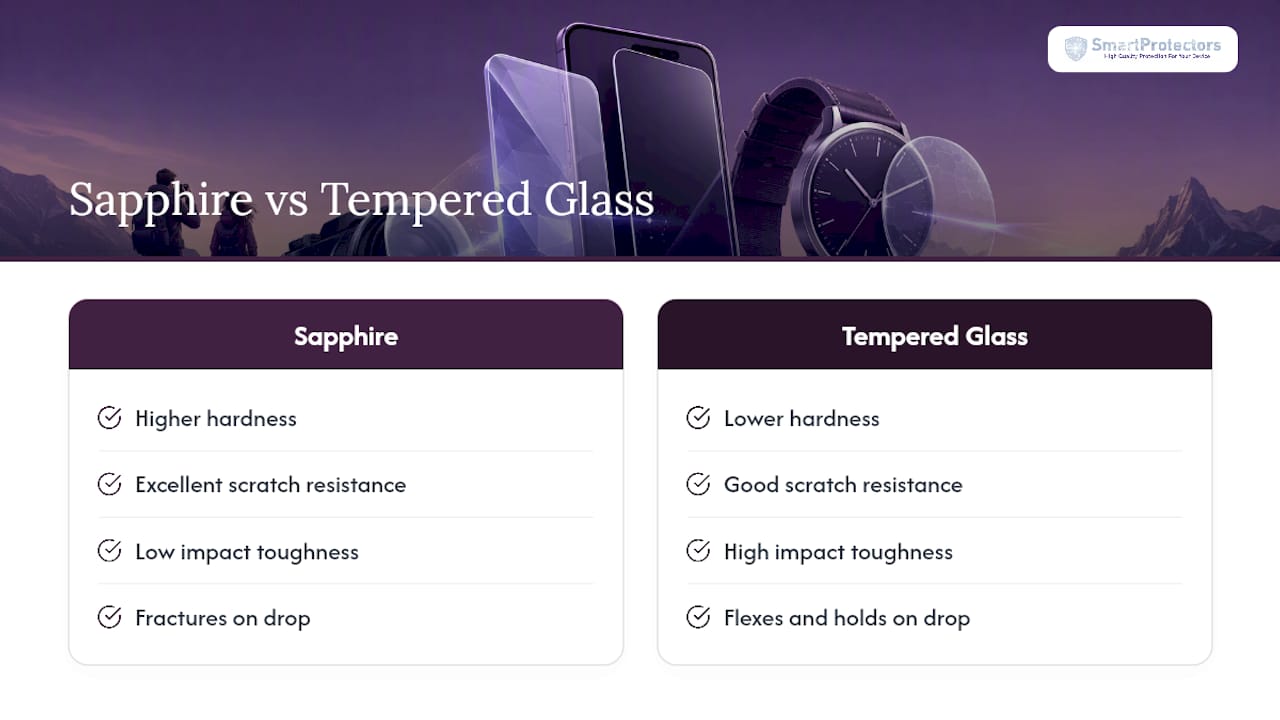
The practical upshot is that you’re rarely choosing “the better material” in absolute terms. You’re choosing which failure mode you’d rather risk. A sapphire protector on a phone that gets dropped weekly is optimised for the wrong threat. A tempered glass protector on a watch that spends its life brushing against a desk edge is optimised for the wrong threat in the other direction.
What the sapphire premium actually buys you
Sapphire protectors cost noticeably more than tempered glass equivalents, and the gap is bigger for phone-sized panels than for small watch crystals, largely because larger sapphire sheets are harder to grow and cut without flaws. That price difference isn’t inflated for the sake of it. Growing synthetic corundum, cutting it precisely, and polishing it to optical clarity is a slower, more demanding process than tempering standard glass.
Whether that premium is worth paying comes down to how you’d otherwise replace a scratched screen protector. If you’d normally swap a tempered glass protector every six to twelve months as it accumulates fine scratches, a sapphire protector that stays pristine for several years can work out cheaper over time, even at three or four times the upfront cost. If you replace protectors mainly because they crack from drops rather than wear out from scratches, sapphire’s price premium buys you very little, since it doesn’t solve the problem you actually have.
Value for money here isn’t a fixed answer. It depends entirely on which failure mode is currently costing you money.
Chipped edges and cracked coatings: how sapphire protectors actually fail
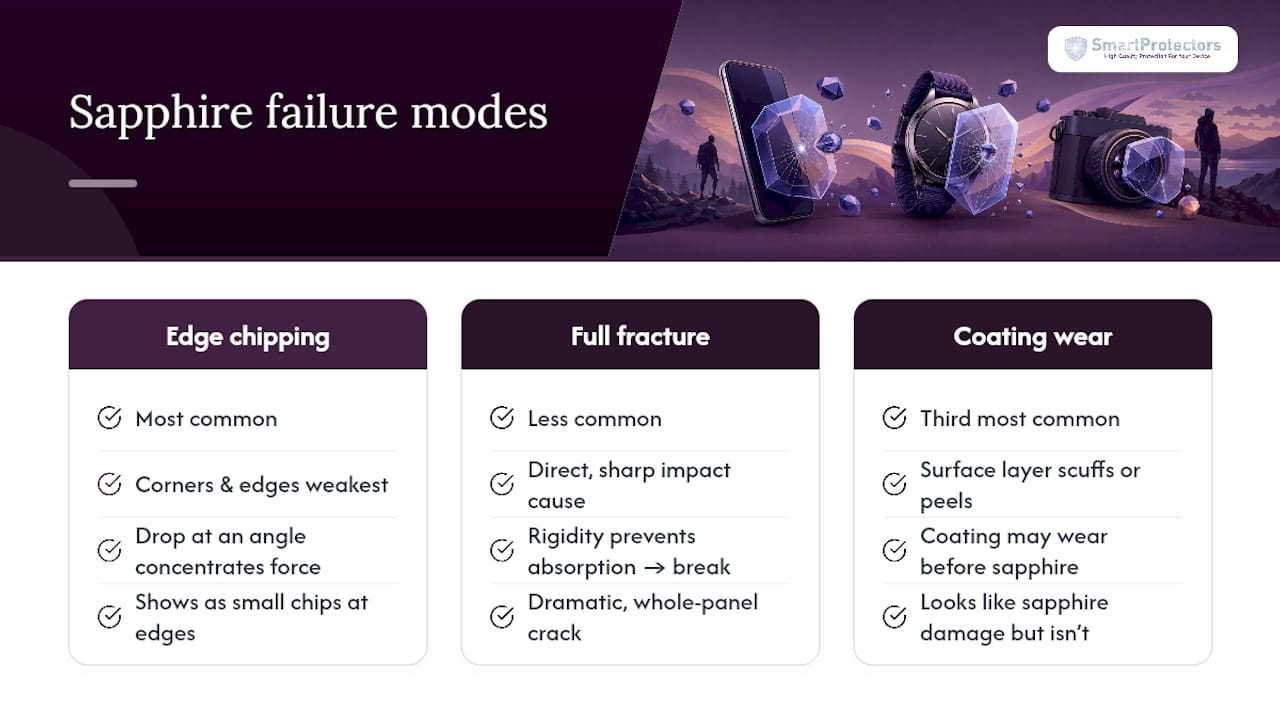
Sapphire rarely fails the way people expect. Because it resists scratching so effectively, most owners assume the surface is close to indestructible. In practice, the failure that shows up most often is edge chipping, not surface scratching. The corners and edges of a sapphire panel are its weakest points structurally, and a drop that lands at an angle concentrates force exactly there.
Full fracture is less common than chipping but more dramatic when it happens, usually from a direct, sharp impact rather than a general drop. This is the trade-off covered earlier in concrete terms: the same rigidity that keeps sapphire from scratching also means it has nowhere to absorb sudden force except by breaking.
Coating wear is the third and most misleading failure mode. An anti-reflective or oleophobic layer applied over sapphire can scuff, haze, or peel at the edges well before the sapphire underneath shows any damage at all, and to the naked eye that looks identical to the sapphire itself failing. Checking whether a coating is bonded into the material or simply layered on top, as covered in the buying checklist above, tells you which failure you’re actually likely to see first.
Where sapphire earns its price, and where it doesn’t
The conventional advice on sapphire protectors treats “hardest material available” as the whole argument, and that’s where most buying guides go wrong. Hardness is genuinely the wrong single metric for a phone that gets dropped often. What the evidence actually supports is a much narrower recommendation: sapphire earns its price on devices that face constant low-grade abrasion and rarely face hard impacts, which describes a watch face far better than it describes most smartphones.
I’d push back on the instinct to treat sapphire as a universal upgrade. It isn’t one. It’s a specialist material solving a specific problem, and paying its premium on a device that mainly suffers drop damage is a mismatch, not an upgrade. The reader’s first question shouldn’t be “is sapphire better than glass?” It should be “which of my two realistic failure modes, scratching or cracking, actually costs me money?” Answer that honestly and the material choice mostly makes itself.
What’s overrated is brand messaging that implies sapphire is scratch proof full stop. It isn’t, quite. Diamond scratches it, and coatings on top of it scratch well before Mohs 9 comes into play. What’s underrated is asking about coating placement before you buy, since that single question predicts more real-world disappointment than the base material ever does.
— Dian
Finding the right protector for your device
Beyond sapphire, most everyday devices are still best served by well-made tempered glass, and SmartProtectors carries options built around exactly the trade-offs covered above rather than a one-size-fits-all pane. For Samsung’s current flagships, the IMAK full coverage protector for Galaxy S25 and S24 bonds edge to edge with a dust-free installation tool and keeps fingerprint unlock working, solving the fit and bonding issues raised earlier without any guesswork on your part.
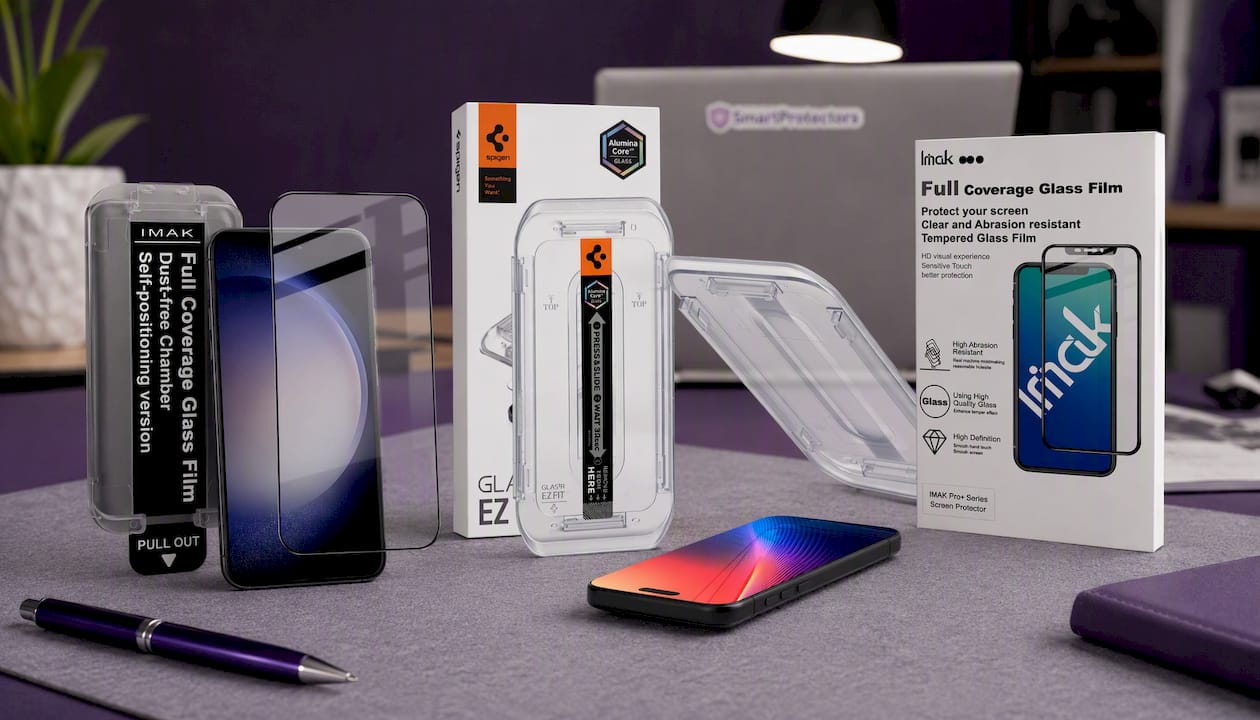
If you’re on Apple’s newest range, the Spigen GLAS.tR EZ Fit for iPhone 17 comes as a two-pack with sensor cutouts already aligned, so Face ID and proximity sensors work exactly as before installation. For a lower-cost Android model, the IMAK Pro+ protector for Galaxy A27 delivers solid everyday scratch protection without the premium price tag, a sensible pick if your device sees more pocket wear than pavement drops.
Not sure which fits your model, or shopping for a device that isn’t listed yet? Get in touch through SmartProtectors and submit a sourcing request. Pick based on your device model and how it actually gets used day to day, and you’ll land on the right protector without needing sapphire’s price tag for a phone that doesn’t need it.
Sources
- Is sapphire screen protector worth it? Sapphire vs tempered glass – MakeUseOf
- Sapphire Screen Protector Review: Scratch Resistance vs Drop Protection Explained — Phone Repair Guru
- Sapphire vs mineral vs Hardlex watch glass (2026) – Watch Enclave