

Smartwatch screen protectors fall into four main categories: tempered glass, polymer film, hybrid, and liquid coatings. Each type offers a different balance of scratch resistance, impact absorption, touch sensitivity, and visual clarity. Choosing the wrong type for your device model or lifestyle means paying for protection you either cannot feel or cannot rely on. This guide covers every major smartwatch screen protector type, explains how each material behaves in real use, and helps you match the right option to your watch and daily habits.
What are the main smartwatch screen protector types?
The four core materials define almost every product on the market. Understanding what each one does well, and where it falls short, is the fastest way to narrow your choice.
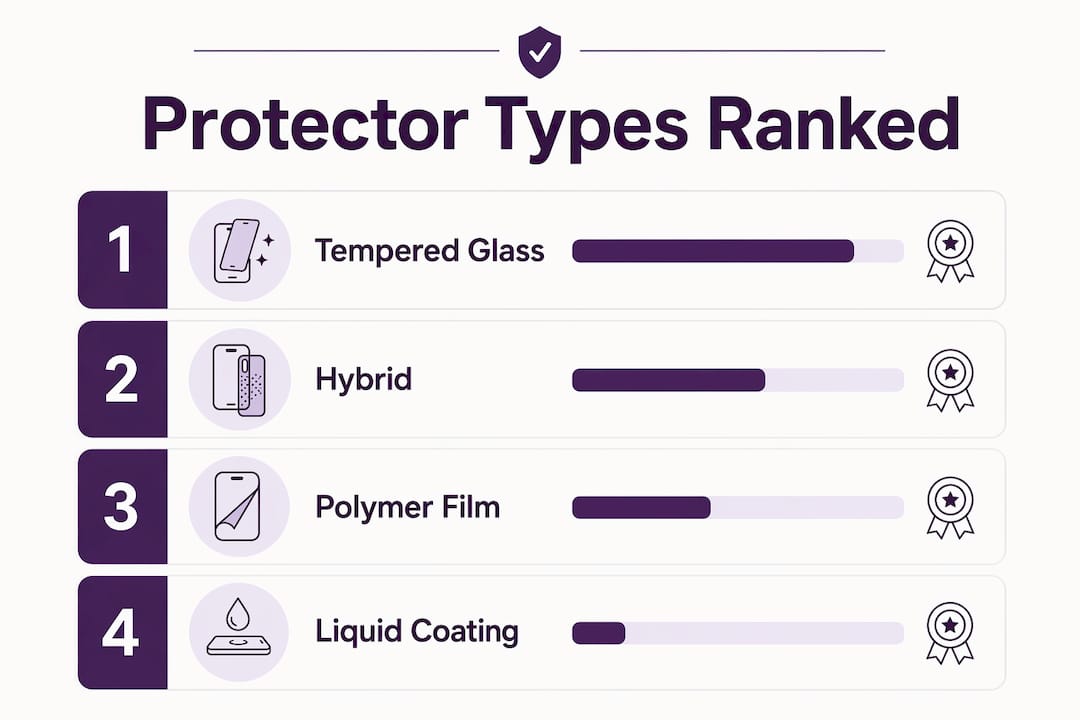
Tempered glass
Tempered glass is the most popular choice for flat-screen smartwatches. It offers superior scratch resistance and a touch feel almost identical to bare glass. That familiar feel matters because smartwatch gestures rely on precise swipe detection. Tempered glass is also stiffer than film, which means it absorbs impact energy better when a watch face hits a hard surface. The trade-off is thickness. Tempered glass adds a small but measurable amount of bulk, and it can struggle to adhere cleanly to curved watch faces.
Polymer film
Polymer film protectors are thinner and more flexible than glass, which makes them easier to apply and far less likely to crack on impact. They conform to gentle curves better than rigid glass. The weakness is durability. Film provides meaningful scratch protection but offers limited resistance to sharp impacts. Over time, films can develop surface scratches that cloud the display. They are a sensible choice for users who prioritise a low-profile fit over maximum toughness.
Hybrid protectors
Hybrid protectors combine a glass-like hard surface with a flexible backing layer. The result is a protector that sits between tempered glass and film in both rigidity and adaptability. Hybrid options handle mild curves better than pure glass while offering more surface hardness than plain film. They suit users who want a middle ground without committing to the bulk of tempered glass or the fragility of thin film.
Liquid coatings
Liquid screen protectors are applied as an invisible coating that bonds to the glass surface at a microscopic level. They add no visible thickness and do not affect touch sensitivity at all. The limitation is significant: liquid coatings provide almost no impact protection. They reduce fine surface scratches but will not prevent a cracked display from a sharp knock. Liquid coatings work best as a supplement to a physical protector, not as a standalone solution.
| Type | Scratch resistance | Impact resistance | Curved screen fit | Thickness |
|---|---|---|---|---|
| Tempered glass | Excellent | Good | Challenging | Moderate |
| Polymer film | Moderate | Low | Good | Very thin |
| Hybrid | Good | Moderate | Moderate | Low to moderate |
| Liquid coating | Low | Minimal | Perfect | None |
How do protectors interact with curved and flat smartwatch screens?
Screen shape is the single biggest factor that determines whether a protector fits properly. Flat rectangular screens, common on many Android smartwatches, accept tempered glass with few complications. Circular or heavily curved displays, found on many popular round-face watches, create real adhesion challenges for rigid materials.
Edge-to-edge protectors designed for curved displays maintain full coverage and reduce the edge lifting that plagues standard flat-cut glass on curved faces. A protector that lifts at the edges collects dust and moisture underneath, which accelerates peeling and can interfere with touch response near the screen border. Buying a protector cut specifically for your watch model, rather than a generic size, is the most reliable way to avoid this problem.
Protector thickness also affects case compatibility. Thicker tempered glass protectors can interfere with snap-on bumper cases if the product is not labelled as case-friendly. A case-friendly protector leaves a small perimeter gap so the case edge sits flush without pushing the protector up. If you plan to use both a protector and a bumper case, check for that label before buying either product.
Pro Tip: If you use a bumper case with your smartwatch, choose a case-friendly tempered glass protector. The small perimeter gap prevents the case from lifting the protector edges over time.
Rugged full-body cases with integrated screen protectors offer the highest impact protection but often reduce touch sensitivity and add noticeable bulk. For most everyday users, a standalone screen protector paired with a slim bumper case gives better usability than a full-body case alone.
What affects installation and everyday use?
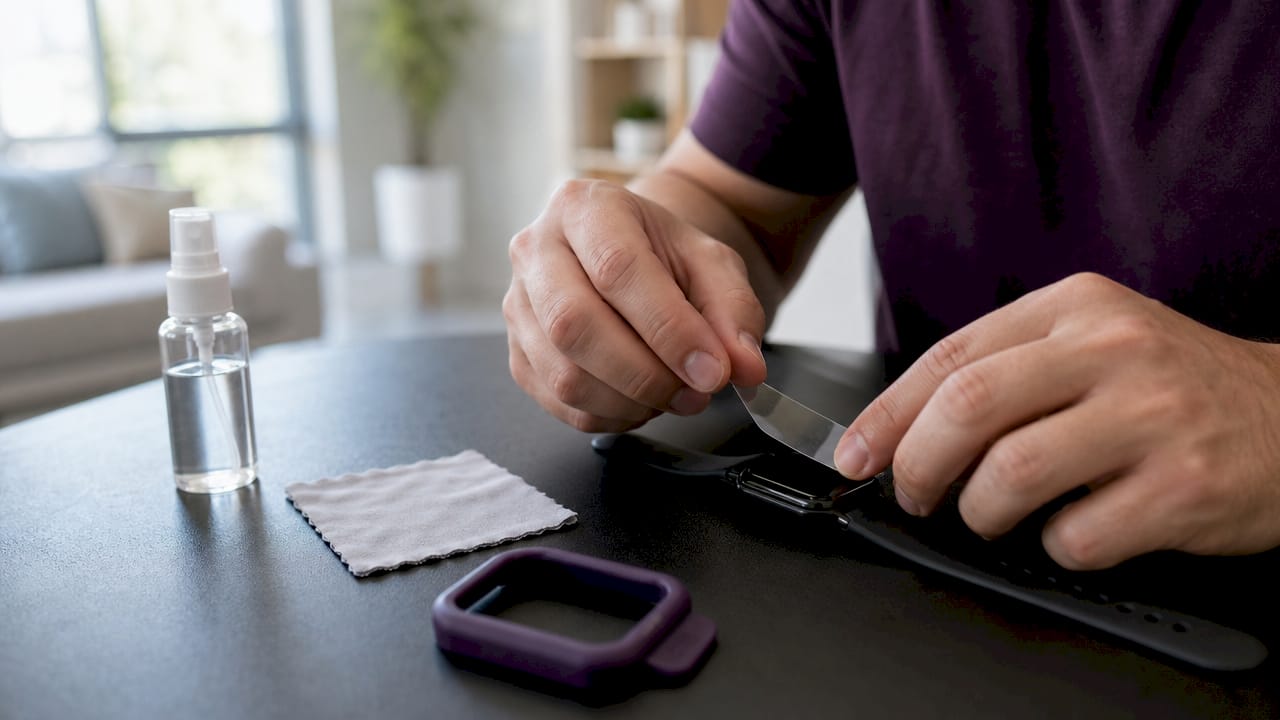
Correct installation determines how long any protector lasts and how well it performs. A poorly applied protector, regardless of material quality, will lift, bubble, and degrade far faster than its design allows.
- Choose a humid environment. Applying protectors in a steamy bathroom reduces airborne dust that causes micro-bubbles under the adhesive. Run a hot shower for two minutes, then apply the protector before dust resettles.
- Clean the screen thoroughly. Use the alcohol wipe and microfibre cloth included in most kits. Any residue or fingerprint oil under the protector will create a permanent cloudy patch.
- Align before pressing down. Hold the protector above the screen and check alignment before committing. Tempered glass is nearly impossible to reposition once the adhesive makes contact.
- Press from the centre outward. Use a card or squeegee to push air bubbles toward the edges. Small bubbles often disappear within 24 hours as the adhesive fully bonds.
- Avoid removing and reapplying. Most tempered glass protectors lose adhesive strength after removal. Film protectors are slightly more forgiving but still degrade with repeated repositioning.
Pro Tip: Keep the alignment tab or guide frame that comes with your protector. It makes repositioning far easier and dramatically reduces the chance of a crooked fit.
Anti-fingerprint coatings on certain protectors keep the display legible during workouts and in bright outdoor light. If you wear your watch during exercise, look for this feature specifically. A smeared screen in direct sunlight is a genuine usability problem, not just an aesthetic one.
Tempered glass preserves touch sensitivity well when correctly installed, though very thick options may slightly affect edge gesture recognition. Thin film and hybrid protectors rarely cause any sensitivity issues at all.
How to choose the right type for your lifestyle
The best protection strategy starts with identifying what your watch actually faces each day. Scratch risk and impact risk are different problems that require different solutions.
- High scratch risk, low impact risk. Office workers and commuters who knock their watch against desks, bags, and door frames face constant fine scratching. Polymer film or a quality hybrid protector handles this well without adding bulk.
- High impact risk. Builders, cyclists, and outdoor workers need tempered glass or a hybrid with a hard surface layer. Film alone will not absorb the energy of a sharp knock against a tool or handlebar.
- Gym and sport use. Sweat and repeated contact with gym equipment accelerate surface wear. Tempered glass with an anti-fingerprint coating keeps the display clear and resists the oils and moisture that degrade film protectors faster.
- Aesthetic priority. Users who want zero visible change to their watch face should consider ultra-thin film or a liquid coating. Neither alters the display appearance in normal lighting.
- Budget. Polymer film protectors cost significantly less than tempered glass and are often sold in multi-packs. If you are prone to replacing protectors frequently, film offers better value per unit.
The best approach, as noted by protection specialists, is to identify your protection needs before purchasing. Buying the toughest option available without considering your actual risk profile often results in unnecessary bulk that impairs daily functionality. A correctly chosen mid-range protector outperforms an over-specified one that you find uncomfortable to wear.
For Apple Watch users specifically, the apple watch screen protector vs case debate comes down to this: a screen protector alone handles the most common damage (scratches and minor knocks), while a bumper case adds frame protection. Combining both gives the most complete coverage without the bulk of a full-body case.
Key takeaways
Choosing the right smartwatch screen protector type requires matching material properties to your actual risk profile, screen shape, and case setup.
| Point | Details |
|---|---|
| Tempered glass suits flat screens | It offers the best scratch and impact resistance but can lift on curved displays. |
| Film fits curves better | Polymer film conforms to rounded watch faces and adds minimal bulk. |
| Hybrid is the middle ground | Hybrid protectors balance surface hardness with flexibility for mild curves. |
| Installation environment matters | Apply in a humid room to prevent dust bubbles and improve adhesion. |
| Case-friendly label is critical | Choose case-friendly protectors to prevent bumper cases from lifting edges. |
What I have learnt from years of watching people get this wrong
I have seen the same mistake repeated constantly. Someone buys the thickest, hardest tempered glass protector available, installs it in a dry room with the TV on, and wonders why there are bubbles under the edges and the case no longer clips on properly. The protector is not the problem. The process and the product selection are.
The detail most people overlook is the relationship between protector type and screen shape. A flat-cut tempered glass protector on a circular watch face will always lift at the edges eventually. It is physics, not a quality defect. Buying a protector cut for your exact model, from a supplier who stocks device-specific options, eliminates this entirely. I have found that choosing the right tempered glass for your specific watch model is more important than the brand name on the packaging.
The other thing I would push back on is the idea that more protection always means better protection. A full-body rugged case with a built-in screen protector sounds impressive, but if it makes your touch gestures unreliable or adds so much bulk that you stop wearing the watch, it has failed at its job. The best protector is the one you keep on the device every day.
SmartProtectors has the right fit for your watch
Finding a screen protector that matches your exact smartwatch model should not require hours of searching across unreliable listings.
SmartProtectors stocks tempered glass, polymer film, and hybrid protectors for a wide range of smartwatch models, with options suited to both flat and curved displays. Every product is selected for quality and value, so you get genuine protection without overpaying. If your specific device is not yet listed, you can submit a request and SmartProtectors will source and add it to the catalogue promptly. Browse the full range at SmartProtectors and find the right protector for your watch today.
FAQ
What is the toughest type of smartwatch screen protector?
Tempered glass is the toughest option for flat screens, offering the best combination of scratch and impact resistance. For curved screens, a hybrid protector provides comparable toughness with better adhesion.
Does a screen protector affect touch sensitivity?
Tempered glass and thin film protectors preserve touch sensitivity well when correctly installed. Very thick or poorly fitted protectors may slightly reduce edge gesture accuracy.
Can I use a screen protector and a bumper case together?
Yes, but choose a case-friendly protector that leaves a small perimeter gap. Standard tempered glass protectors can cause bumper case edges to lift or pop off if the fit is too tight.
Which screen protector type is best for gym use?
Tempered glass with an anti-fingerprint coating is the best choice for gym use. It resists sweat and oils that degrade film protectors, and keeps the display legible under bright light.
Are liquid screen protectors worth buying?
Liquid coatings reduce fine surface scratches but provide almost no impact protection. They work best as a supplement to a physical protector rather than as a standalone solution.
Recommended
- Acrylic Glass Screen Protector IMAK For Apple Watch Series 10 / 11 (42mm)
- Durable Acrylic Glass Screen Protector IMAK for Apple Watch Series 9 / 8 / 7 (41mm)
- IMAK For Garmin Venu 4 45mm Screen Protector Anti Scratch PMMA Watch Film
- Durable Acrylic Glass Screen Protector IMAK For Garmin Fenix 8 Solar (51mm)
- Acrylic Glass HD Screen Protector IMAK For Garmin Forerunner 570 (47mm)
- Find out more brands and models here.