

No. Edge-to-edge protectors are rarely interchangeable, even between phones that look identical side by side. A camera bump shifted by two millimetres or a bezel curve tweaked between generations is enough to ruin the fit. Before buying, check the seller’s compatibility code or run your exact model through a compatibility checker. Curved, full-coverage glass is the least forgiving type, so treat it with the most suspicion.
TL;DR:
- Compatibility of edge-to-edge protectors depends on precise model codes, camera bump, corner radius, and sensor placement, rarely allowing interchangeability.
- Curvature mismatches and misaligned cutouts are the main causes of protectors lifting or bubbling at the edges, especially on highly curved screens.
- Checking compatibility requires searching manufacturer lists, using dedicated tools, and physically dry-fitting protectors before purchase.
- Flexible PET film is best for highly curved displays, while flat or 2.5D tempered glass suits minimal curves; full-coverage curved glass offers the closest fit but risks lift.
- Early-repair, cleaning, and correct alignment are key to fixing edge lift; otherwise, mismatched cutouts usually require replacement.
Table of Contents
- Which phones share the same edge-to-edge protector fit?
- Why do edge-to-edge protectors lift or fail at the edges?
- How do you check compatibility before you buy?
- What protector style actually suits an edge-to-edge screen?
- How do you fix edge lift once it’s already installed?
- How SmartProtectors helps you get an exact fit
- Get the right fit the first time with SmartProtectors
- Sources
Which phones share the same edge-to-edge protector fit?
Manufacturers and sellers group compatible phones under model codes, sometimes called K-codes, because “iPhone 15 Pro” or “Galaxy S23” alone doesn’t tell you enough about the glass beneath. Two phones can share a screen size on paper and still need completely different cuts, because compatibility depends on corner radius, camera island position, and where the earpiece or sensor cutouts sit.
In practice, some generations do overlap. Certain iPhone 15 protectors may fit the iPhone 16 when the outer dimensions and cutouts line up exactly, although corner radius and sensor placement still need checking case by case, as compatibility charts suggest. That’s the exception, not the rule.
Where compatibility usually breaks down:
- Pro versus standard variants: a Pro model’s larger camera housing often needs a different cutout even when the screen size matches the standard version.
- Consecutive generations: the iPhone 14 Pro, 15 Pro, and 16 Pro each shifted camera bump dimensions enough that protectors built for one generally do not sit flush on the next.
- Regional variants: some Galaxy and Huawei models ship with different sensor layouts depending on the market, which changes cutout placement even under an identical model name.
- Ultra and Plus tiers: the extra curvature on Ultra-class Samsung displays means a flat-cut protector for the standard model will bubble along both edges.
Treat any “also fits” claim as a starting point for verification, not a guarantee.
Why do edge-to-edge protectors lift or fail at the edges?
Curvature is the biggest culprit. A rigid glass protector cut for a flat panel will bridge across a curved display instead of following it, leaving a visible gap that eventually lifts. Galaxy S Ultra models and other heavily curved phones need glass cut to that exact curve, or the edges will bubble within days, as compatibility checkers built for this exact problem point out.
Cutouts matter just as much. Every notch for a speaker, ambient light sensor, or camera island has to align within a fraction of a millimetre, because tempered glass doesn’t flex to compensate for a misplaced hole. The same logic applies outside phones. Edge trim manufacturers such as Trim-Lok publish leg length and minimum radius specifications for exactly this reason: an edge guard cut for the wrong radius won’t sit flush, whatever material it’s made from.
Adhesive design is the third factor. Edge-only adhesive, common on full-coverage tempered glass, relies on a thin border of glue rather than a full sheet of adhesive across the surface. That border has almost no tolerance for a curvature mismatch or trapped dust, which is why edge lift is the single most reported complaint with this protector type.
How do you check compatibility before you buy?
Three checks catch most mismatches before money changes hands.
- Search the manufacturer or seller’s fit list. Look for the exact model code, not just the marketing name, since “Galaxy S23” and “Galaxy S23 Ultra” are different products with different curvature.
- Run your model through a dedicated compatibility tool. Services such as PhoneMatch index thousands of phone models against compatible protector and case codes, which cuts down guesswork significantly.
- Do a physical dry-fit if you can. Lay the protector over the screen before peeling any backing film, and check whether it clears the camera housing, sits centred over the earpiece cutout, and meets the edge without a visible gap.
Pro Tip: Photograph the protector held against your screen before installing it. If the corners don’t sit flush in the photo, they won’t magically settle once you’ve committed adhesive to glass.
Sellers who publish explicit model codes rather than vague “universal fit” claims cut down on accidental returns, which is exactly why checking those codes first saves both money and frustration.
What protector style actually suits an edge-to-edge screen?
Material and cut style decide how forgiving a protector is once it meets your phone’s curve.
- PET film flexes naturally around curved edges, which makes it the safest choice for high-curvature displays, though it scratches more easily than glass over time.
- Tempered glass, flat or 2.5D offers the clearest touch feel and best scratch resistance, but only on phones with minimal edge curvature, since rigid glass can’t bend to follow a steep curve.
- Flexible TPU screen film sits between the two, bending further than glass while resisting scratches better than plain PET.
- Full-coverage curved glass, built specifically to match one device’s curvature, gives the closest thing to true edge-to-edge coverage but carries the highest risk of lift if the cut is even slightly wrong.
Forum threads discussing whether true edge-to-edge protectors exist show plenty of Samsung owners frustrated by persistent edge gaps on curved models. Resetting the expectation helps: a slightly smaller cut that stops just short of the curve, paired with a case, often looks and performs better in daily use than a full-coverage protector fighting the curvature. A case with reinforced edges can also mask a slightly imperfect edge protector fit by covering the border where lift usually starts. Camera protectors add another variable, since a poorly matched lens cover for a Motorola Edge 20 Pro or similar model can sit slightly proud of the housing and interfere with a case’s fit.
How do you fix edge lift once it’s already installed?
Most edge lift is fixable without buying a replacement, provided you catch it early.
- Clean the screen properly first. Use the alcohol wipe and dust-removal sticker most protectors include, and work in a low-dust room rather than rushing the job.
- Align before you press. Use the screen’s edges or a built-in alignment frame as your guide, and lower the protector flat rather than tilting one edge in first.
- Press outward from the centre. Push trapped air and adhesive towards the edges in overlapping strokes, rather than pressing edges first.
- If an edge still lifts after 24 hours, lift that section gently, add a small dot of edge-specific adhesive if the kit includes one, and press again with light, even pressure. A few seconds of gentle heat from a hairdryer on its lowest setting can also help stubborn adhesive settle.
- If lift persists after a second attempt, the cut is likely wrong for your exact model rather than the installation. At that point, replacement is more reliable than repeated fixing.
Pro Tip: Keep the original packaging and receipt until you’ve tested the protector for at least 48 hours. Most sellers who offer a verified-fit guarantee will only honour a return within that early window.
If a product was sold as compatible with your specific model code and still doesn’t sit right, that’s a seller conversation, not a you problem.
How SmartProtectors helps you get an exact fit
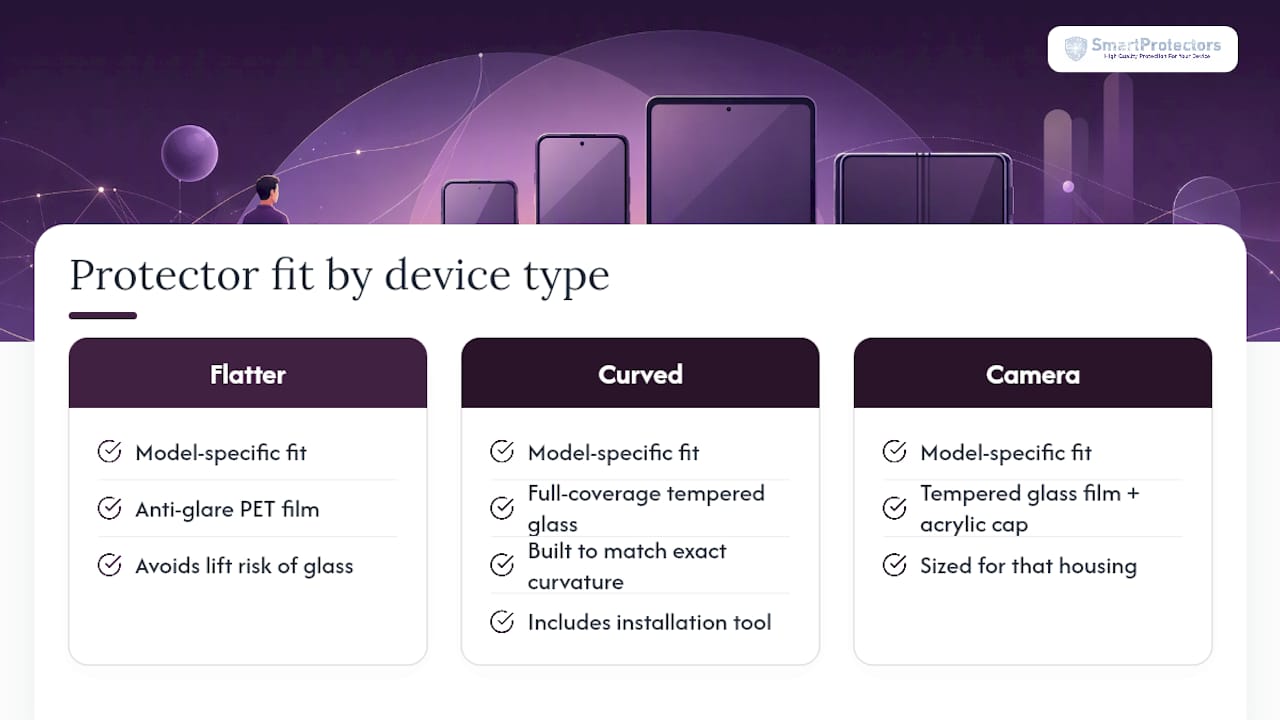
SmartProtectors builds its catalogue around model-specific fit rather than generic “universal” claims, which matters given how often edge-to-edge compatibility comes down to a single camera bump or curvature difference. For flatter displays like the iPhone 15 range, an anti-glare PET film handles the edge curve without the lift risk that rigid glass carries. For heavily curved screens such as the Galaxy S24 Ultra, a full-coverage tempered glass set with its own installation tool is built to match that exact curvature rather than approximate it.
Camera protection follows the same logic. IMAK lens covers for models like the Galaxy S23 Ultra and S23/S23+ pair tempered glass film with an acrylic lens cap sized for that housing specifically, rather than a one-size guess.
Can’t find your exact model listed? Submit a request through SmartProtectors and the team sources it for the catalogue, rather than leaving you stuck with a mismatched universal fit or wondering how to sell your phone in Miami for quick cash today.
Get the right fit the first time with SmartProtectors
Generic “fits most phones” protectors are how most edge-lift complaints start, and it’s exactly the problem SmartProtectors was built to solve: every screen protector, lens protector, and case in the catalogue is listed against specific model codes, not vague size ranges.
If your phone has a curved display, start with something cut for that curve rather than a flat sheet forced into place. The anti-glare PET film for iPhone 15 and iPhone 15 Pro flexes around the edge naturally, while the Spigen GLAS.tR EZ Fit protector for the iPhone 17 series comes with an alignment frame that removes the guesswork installation checklists usually have to cover. Galaxy S24 Ultra owners get a full-coverage tempered glass set with its own installation tool built for that display’s exact curvature, rather than a flat cut adapted after the fact.
Own a device that isn’t listed yet? Submit a request through SmartProtectors and the sourcing team will track it down and add it to the catalogue, so you’re never stuck choosing between a poor-fitting universal protector and no protection at all.
Sources
- Screen Protector Compatibility Checker | Find the Right Fit | Tech Fix & Trade Ruislip
- PhoneMatch - Find Compatible Screen Protectors & Cases | Search Thousands of Phone Models
- Are there no edge to edge screen protectors? : r/samsung