

If you scratch your screen a lot but rarely drop it, a self-healing hydrogel or TPU film is the smarter buy, since minor marks fade on their own within hours. If you’re accident-prone or your phone gets dropped, tempered glass wins on raw impact resistance. The trade-off is simple: film heals scratches but yields on hard drops; glass survives drops but scratches for good. The buying checklist below sorts out which one fits your habits.
TL;DR:
- Self-healing films repair minor surface scratches within seconds to hours, but deep gouges or cracks remain visible and need replacement.
- Tempered glass offers superior impact resistance and prevents screen cracks but does not self-repair scratches, which become permanent.
- Thinner films heal scratches faster but absorb less shock, while thicker films and glass provide better drop protection at a higher cost.
- Proper installation and gentle warming can extend the lifespan of self-healing films, with replacement advised when lifting or deep marks appear.
- Choosing the right protector depends on your risk profile: opt for film if you scratch your screen often and glass if impact damage is your primary concern.
Table of Contents
- What is a self-healing screen protector and how does the healing work?
- Self-healing film vs tempered glass: how do they compare?
- How do you choose the right protector for your phone?
- How do you install and maintain a self-healing screen protector?
- What support does SmartProtectors offer for fitting and rare models?
- Which protector should you actually buy?
- An honest look at self-healing hype
- Get the right protection without the guesswork
- Sources
What is a self-healing screen protector and how does the healing work?
A self-healing screen protector is a thin film, usually made from TPU (thermoplastic polyurethane), EPU (elastic polyurethane), or a hydrogel base, coated with a polymer layer that stays slightly mobile even after it cures. That mobility is the whole trick. When something scratches the surface, the coating slowly flows back into place instead of staying gouged, closing the mark from the inside out rather than filling it with anything new.
Manufacturer specs show real variation in how fast this happens. Some self-healing TPU and hydrogel sheets list healing times anywhere from a few seconds up to 24 hours, depending on coating thickness. A matte EPU film even advertises a “30 second” recovery for light marks, though that figure assumes ideal conditions, a shallow scratch, and warm ambient temperature, not a deep key-scratch in a cold pocket.
Set your expectations by scratch depth, not marketing copy. Fine surface abrasions vanish; anything that’s actually gouged the material stays visible, because the mechanism smooths a disturbed surface rather than rebuilding lost material.
Before buying, check the product page for:
- Healing time stated for light scratches (seconds to hours)
- Film thickness, typically between 0.18mm and 0.22mm
- Light transmittance, which affects how bright and sharp the display looks underneath
Self-healing film vs tempered glass: how do they compare?
Here’s the honest split: self-healing film wins on scratch recovery and curved-screen fit; tempered glass wins on impact resistance and long-term optical hardness. Neither beats the other outright, because they’re solving different problems.
Durability and impact resistance. Tempered glass consistently rates harder and is more likely to stop a screen cracking on a hard drop. Film flexes and absorbs some shock, but it won’t stop a corner-first drop onto concrete the way glass can.
Scratch behaviour. This is where film earns its name. It repairs the fine surface marks from keys, coins, and pocket grit, but it can’t fix a deep gouge or a crack, since the polymer coating only smooths what’s disturbed on the surface, according to technical explainers on self-healing mechanisms. Glass simply doesn’t self-repair at all: once it’s scratched, that mark is permanent.
Clarity and touch feel. Good film and good glass both deliver clear optics and oleophobic coatings that resist fingerprints, though film sometimes has a very slightly softer touch response than glass.
Case and curved-screen fit. This is film’s quiet advantage. Rigid glass can struggle to bond edge-to-edge on curved displays, leading to white edges or lifting, while flexible film wraps the curve and typically produces fewer lifting issues, according to supplier testing on adhesion formulations.
Price and lifespan. Film tends to sit at a lower price point but wears out faster; glass costs more but lasts longer before it needs replacing, assuming it survives that long without cracking.
Thickness also drives a direct trade-off worth understanding: thinner film bases heal scratches faster but absorb less impact, while thicker bases sacrifice healing speed for better shock absorption, per Reedee’s product comparisons.
- Prioritise scratch recovery and curved-screen fit → self-healing film
- Prioritise drop protection and long-term hardness → tempered glass
- Want both, imperfectly → a hybrid or a case-friendly tempered glass with rounded edges
How do you choose the right protector for your phone?
Match the protector to your actual risk, not the one you imagine. Someone who tosses their phone screen-down onto a desk fifty times a day has a different problem to someone who works in a warehouse with metal shavings everywhere.
Start with these questions before you buy:
- Do you drop your phone often, or mostly scratch it against keys, coins, or tools?
- Does your phone have a curved-edge display that’s caused fitting problems before?
- Do you want a warranty or replacement guarantee included?
- Are you buying for a common model, or a rarer device that’s hard to find protectors for?
On the product page itself, check for healing time (seconds vs hours matters more than you’d think), thickness, adhesion claims for curved screens, and whether there’s an actual warranty rather than vague “satisfaction guaranteed” language with no terms attached.
Ask sellers directly: “What’s the stated healing time for light scratches?” and “Does this fit curved edges without lifting?” Vague answers are a red flag. So is a listing with no thickness figure, no healing-time claim, and stock photography that doesn’t match the actual product.
Pro Tip: If a listing claims “instant” healing with zero further detail, be sceptical. Genuine specs usually give a range, because healing speed depends on scratch depth and ambient temperature, not a fixed number.
How do you install and maintain a self-healing screen protector?
Getting a bubble-free fit and knowing basic aftercare will extend the life of any film, self-healing or not.
- Clean the screen thoroughly with a lint-free cloth before applying anything, since dust under the film causes permanent bubbles.
- Align the film using the guides provided, lower it slowly from one edge, and use a squeegee card to push bubbles outward. SmartProtectors’ bubble-free installation guide walks through this step by step.
- Speed up scratch recovery with gentle warmth, a hairdryer on its lowest setting held a short distance away, or simply leaving the phone in a warm pocket. Avoid direct high heat or solvents, which can damage the coating rather than help it.
- Clean with a microfibre cloth and water only, avoiding alcohol-based wipes that strip the oleophobic layer over time.
- Replace the film once you see edge lifting, persistent cloudiness that doesn’t clear, or a mark deep enough that heat won’t shift it.
If you’re unsure whether to reapply or replace, SmartProtectors’ guide on reapplying a screen protector covers exactly where that line sits.
What support does SmartProtectors offer for fitting and rare models?
Buying the right protector is only half the job. Getting it on straight and keeping it working matters just as much, which is why SmartProtectors backs every listing with practical guidance rather than leaving buyers to work it out alone.
- Step-by-step installation instructions for a clean, bubble-free application
- A safe removal guide so swapping protectors doesn’t risk the screen underneath
- A product-request service for anyone who can’t find a protector for their exact device, especially useful for rarer phone, tablet, or smartwatch models that mainstream retailers skip
Retailer support like this genuinely reduces returns and frustration, because most fitting problems come down to installation error, not product quality. SmartProtectors focuses on getting protection right without inflating prices for the privilege.
Which protector should you actually buy?
If scratches are your main worry and you want an edge-to-edge finish on a curved screen, buy a self-healing film. If drop protection is non-negotiable, tempered glass is the safer bet, and it remains the more dependable option once you factor in long-term hardness against everyday knocks.
For readers leaning towards glass, three tempered glass options are worth checking:
- The IMAK Pro+ tempered glass protector for iPhone 15, built for full clarity and edge coverage
- The AMORUS tempered glass protector for iPhone 16 Pro, suited to buyers who want drop resistance without sacrificing sharpness
- The IMAK Pro+ series for iPhone 17e and 16e, designed with sensitive-touch response for newer models
| Protector type | Best for | Main trade-off |
|---|---|---|
| Self-healing film | Scratch-prone users, curved screens | Weaker against hard drops |
| Tempered glass | Drop-prone users, long-term hardness | Scratches are permanent |
An honest look at self-healing hype
Most of the marketing around self-healing film oversells the “magic” and undersells the physics. It’s not nanotechnology repairing your screen. It’s a polymer coating that stays slightly soft and flows back into shape, which is genuinely clever engineering, but it has firm limits that a lot of product pages conveniently leave out.
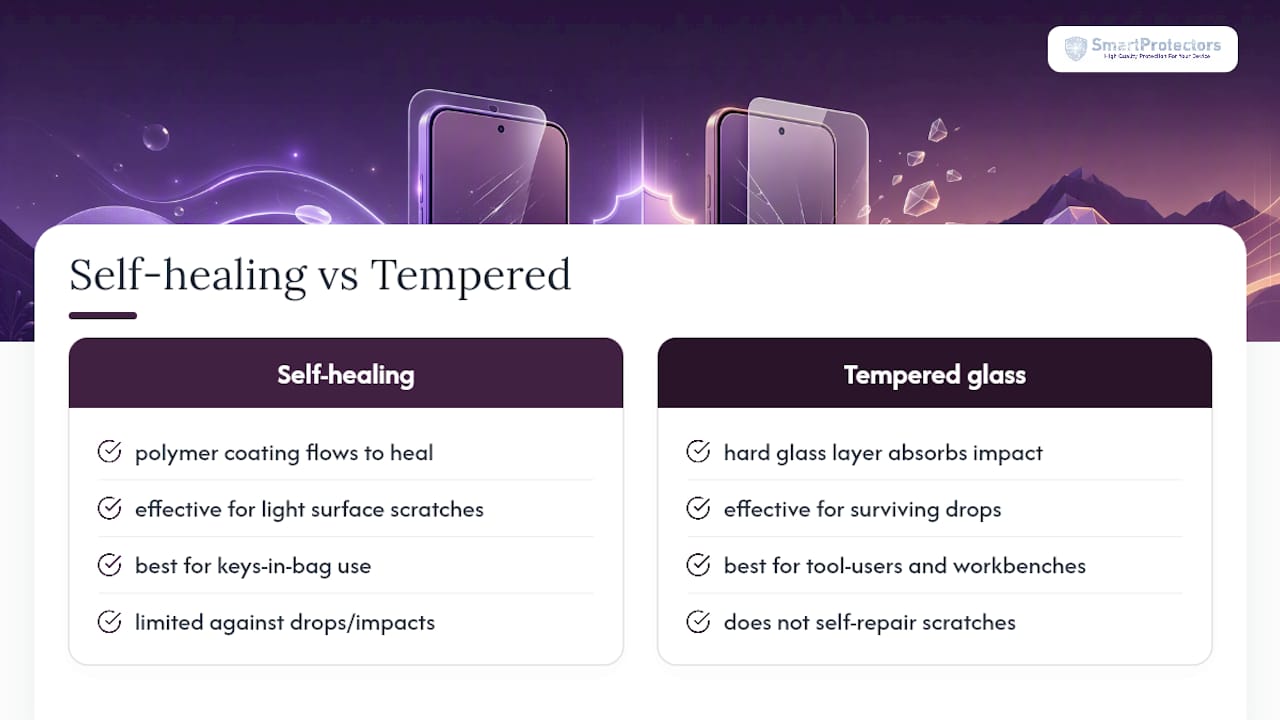
The bigger issue is that buyers often pick based on the coolest-sounding feature rather than their actual risk profile. Someone who works with tools all day doesn’t need a protector that heals scratches. They need one that survives a drop onto a workbench, which means tempered glass, every time. Meanwhile, someone whose only real enemy is keys jangling in a bag alongside their phone is paying for impact resistance they’ll never use.
Buy for your habits, not the feature that sounds most impressive on the box. If you’re unsure which camp you’re in, SmartProtectors’ product-request service exists precisely for the awkward cases in between.
— Dian
Get the right protection without the guesswork
SmartProtectors exists for exactly the decision this article just walked through: matching real device risk to the right protector, without paying agency-style markups for a piece of film or glass. Where big retailers stock a handful of popular models, SmartProtectors also sources protectors for less common phones, tablets, and smartwatches through its request service, so a rarer device isn’t left unprotected just because it’s not mainstream.
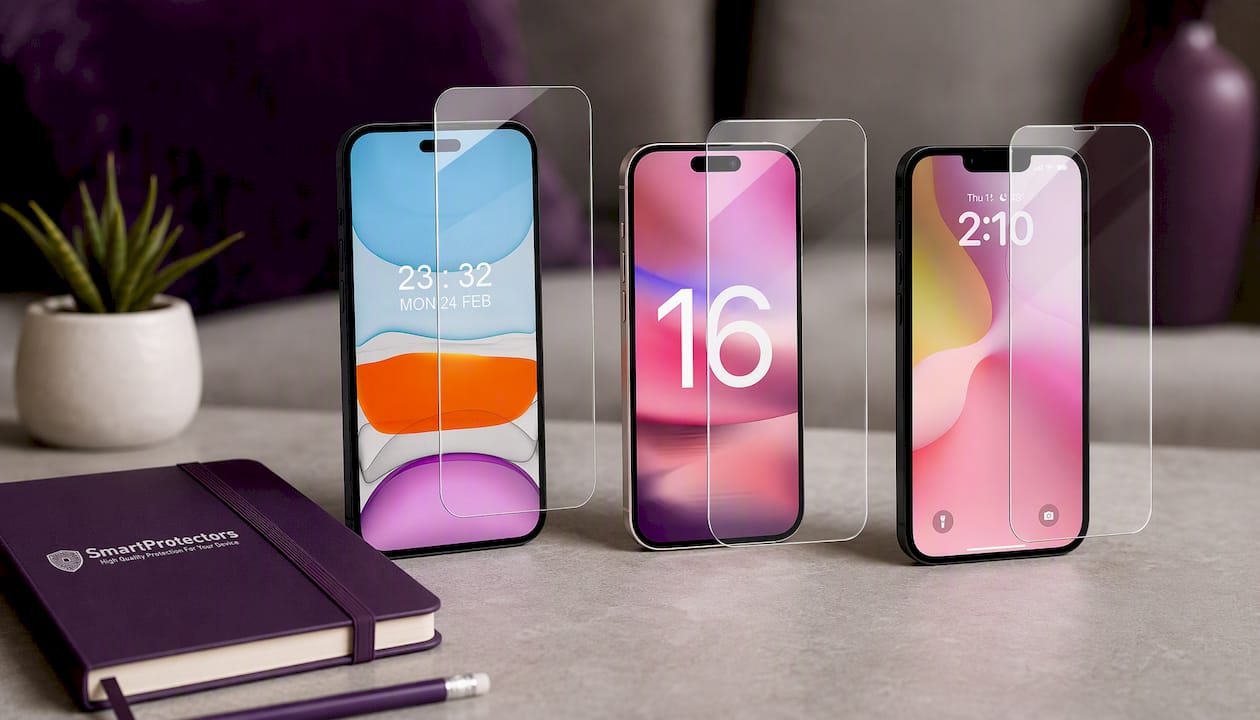
If drop protection matters more than scratch healing for you, the IMAK Pro+ tempered glass protector for iPhone 15 and the AMORUS protector for iPhone 16 Pro both offer solid impact resistance with genuine clarity. Broader device guidance, including for tablets, is available from Atticus Goods’ device guide if you’re protecting more than just a phone.
Browse the current range and find the right fit for your exact model at SmartProtectors, or submit a request if your device isn’t listed yet.
Sources
- Self Healing TPU Hydrogel Film Sheets - Reedee
- 3mk ARC+ Protective Film for iPhone 13 | Ultra-Thin & Self-Healing